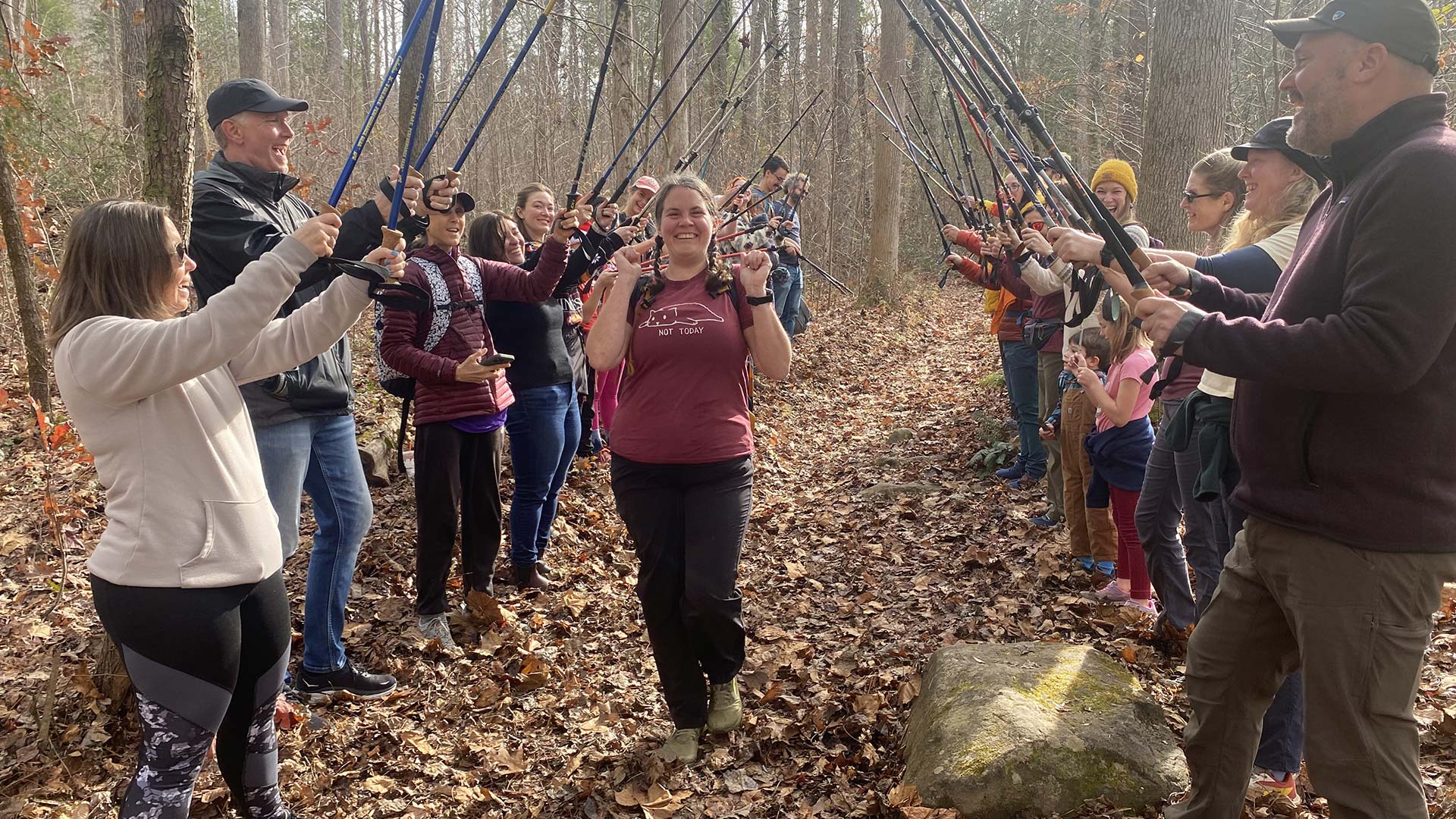
Karen Tobias walked around a curve in the path in the Great Smoky Mountains National Park to see a black bear sitting in a streamlet turning over rocks. It paused, looked at her, then returned to its work.
“It was sitting down with its legs out and its front legs between its back legs, like a dog or stuffed teddy bear,” says the UT College of Veterinary Medicine professor of small animal surgery.
The bear turned over another rock. It looked at her again, then began pushing rocks around the stream.
“It was this interaction that to me felt so deep and spiritual because the two of us were just looking at each other,” she says. “That was the first time that I realized that I’m safe. I’m actually really safe in the wilderness.”
She also had a different experience with another bear during a separate hike in the Smokies. As she walked down a path in an area near a shelter, a black bear advanced on her. She yelled. It didn’t stop. She pulled an airhorn out of her pocket.
“I don’t even know why I packed it that day,” she says.
It took three blasts before the bear ran away.


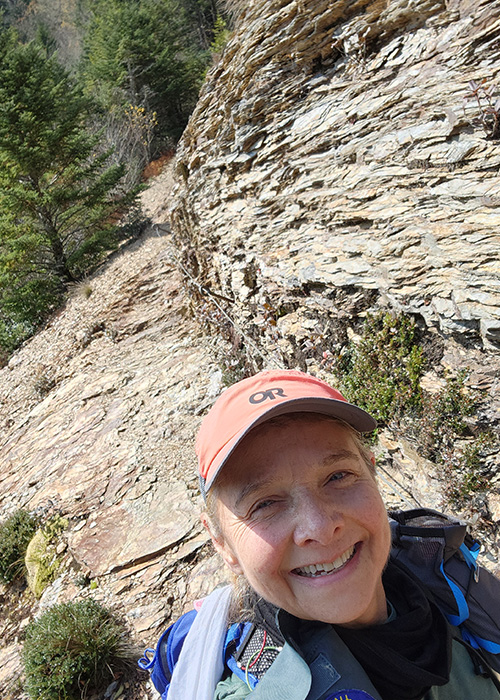
Click to Expand Images
Such can be the adventures along the national park’s trails.
More than 915 individuals, including Tobias, have completed hiking all 900 miles of the park’s trails, which includes 71 miles on the Appalachian Trail, as of May 2026. They form the membership of the Great Smoky Mountains 900 Miler Club, founded in 1995. Members must submit applications and documentation of their hikes.
While technically just under 800 maintained trail miles crisscross the park, to walk them all requires covering some of the same paths to reach other trails. Hikers use maps to track their progress—and to denote the number of times they’ve completed the park’s trails.
Tobias has completed three maps of the park and started her fourth.
Erin Hatfield, UT Knoxville Haslam College of Business communication specialist for the Boyd Center for Business and Economic Research, first heard of the 900 Miler Club when she worked for a Knoxville television station and wrote a story about a man who completed the trails.
“I could never do that,” she thought. “That’s crazy. Who does that?”
She could and did.
Great Smoky Mountains 900 Miler Club
- Founded in 1995 by “Louisiana” Lou Murray.
- Members must complete every trail in the Great Smoky Mountains National Park and provide documentation.
- As of May 9, 2026, more than 915 individuals have completed maps of the park.
- One person has completed the trails 22 times.
- The youngest to hike to all the trails were siblings ages 10 and 8.
Information compiled from the Smoky Mountains Hiking Club website.
Hatfield (Knoxville ’09) completed her first map in December 2024. She has logged more than 300 miles on her second.
While she grew up playing in a national forest in South Carolina, she began hiking trails in East Tennessee’s state parks in 2020 during the COVID-19 pandemic. When she finished those trails, she finally turned to the Great Smoky Mountains National Park. As the miles accumulated in 2021, she recalled the story written years earlier. She checked her maps and miles covered to find she had trekked 100.
With such a start, she set a new goal: become a member of the 900 Miler Club.
Tobias discovered the club through another faculty member, who spoke of how the members encouraged one another to complete their maps.
“I’m one of those people that makes lists and checks them off, and if it’s not on the list and I’ve done it, I add it so I can check it off,” she says.
When Tobias and Hatfield took to the trails, they started with short distances and gradually added miles. Hatfield varies between solo and group treks that may include nights of camping. During one four-day journey over Labor Day weekend, she hiked almost 60 miles.
“You can have really good conversations with people on a 20-mile hike,” she says.
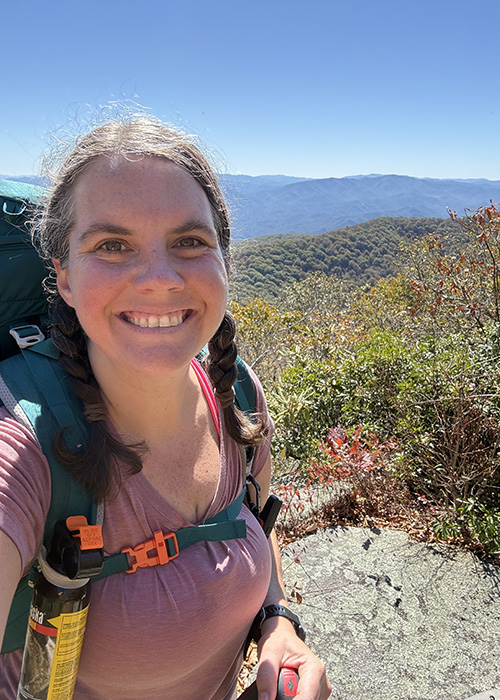

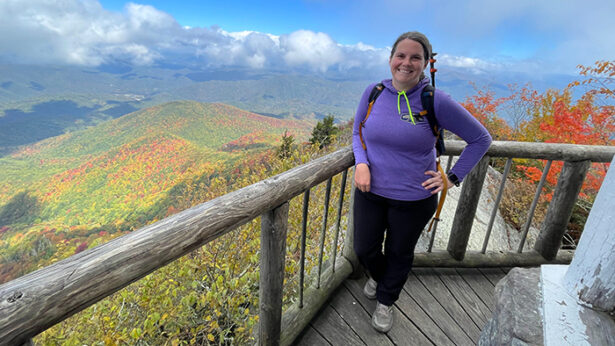
Click to Expand Images
Tobias usually hikes solo and only on day hikes. To finish her third map of the park, she tramped 34 miles.
“I’m 66, and I’m able to say to people, ‘I couldn’t have done this when I was 55 because I didn’t have the practice,’” Tobias says. “I had to build up to this, but now look what I can do.”
It also helps when she faces a challenge outside the park, such as needing to edit 26 textbook chapters. She tells herself, “You’ve accomplished really big, challenging things. Let’s just make your list, let’s divide it into boxes and sections, and let’s tackle it like we do the hikes.”
They each completed the miles of trails one step at a time.
As Hatfield hiked the Eagle Creek Trail, the last steep mile leads to the Appalachian Trail. Exhausted by the arduous day, she found herself stopping every 50 feet to rest.
“At one point, I was like, ‘Why am I doing this? This is dumb. This is so dumb. Why am I doing this?”
She pushed on, halting step by halting step, until the trail’s end.
“Yeah, I got that done. Hell, yeah.” she told herself. “I did that.”
Through the trail miles, blisters and injuries, they learned they could hike through the hard.
10 Hiking Essentials
The National Park Service recommends this collection of basic first aid and emergency items to help hikers with minor injuries, weather changes and unexpected delays.
- Navigation: map, compass or GPS system
- Sun Protection: sunglasses, sunscreen and hats
- Insulation: jacket, hat, gloves, rain shell and thermal underwear
- Illumination: flashlight, lanterns, headlamp
- First-Aid Supplies: adhesive bandages, sterile gauze, antibiotic ointment, tweezers and scissors
- Fire: matches, lighter or fire starters
- Repair Kit and Tools: duct tape, knife, screwdriver, scissors
- Nutrition: extra day’s supply of food, no-cook items with good nutritional value
- Hydration: water and water treatment supplies
- Emergency Shelter: tent, space blanket, tarp