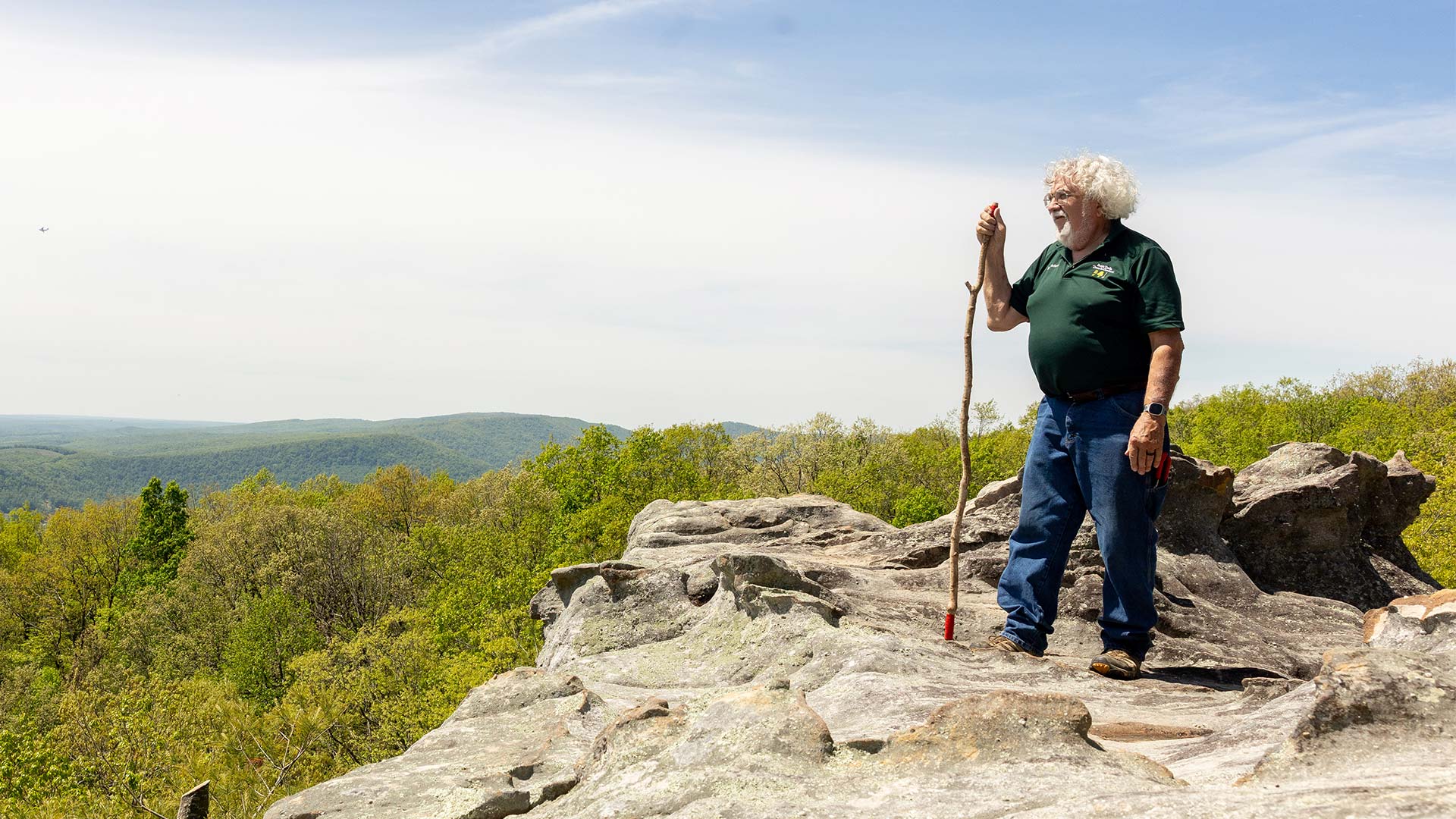
Bob Richards walked through the woods, tying markers on trees. About three days behind him, a five-man crew followed using hand tools to build a trail.
One day as he hiked, he saw black cinder material on the ground but didn’t know what it was or how it got there. Curious, Richards (Knoxville ’75) followed the gentle grade that made a perfect hiking trail. When he completed a four-mile loop, he asked about it. Old timers described an abandoned bed for a dinky line, a short, narrow railroad built for logging in the 1920s.
Richards encountered this history in July 1976 at the edge of 4,650 wooded acres along the Cumberland Plateau on a mission to begin building trails in the now 19,000-acre Savage Gulf State Park in Sequatchie and Grundy counties.
“When I arrived, there were no trails, no road access,” he says. “When I left in 1987, there were 45 to 50 miles of trails, campsites and trailheads.”
During his 50-year career as a trail designer, Richards estimates he had a hand in building more than 200 miles of Tennessee trails. His work won awards, including the 2013 Accessibility Enhancement award from the Coalition of Recreational Trails when he was the volunteer project supervisor for a paved trail and boardwalk at Nashville’s Beaman Park. He edited Pathways to Trail Building, the trail manual used by the state for years.
Richards worked at Fall Creek Falls State Park before he graduated from UT Knoxville and was assigned to Savage Gulf. He rose up the state ranks, serving as the Tennessee state park planner and later the greenways and trails program coordinator. Richards left state government in between and was director of properties and facilities for the Middle Tennessee Girl Scout Council. He retired from the state in 2016. Bob’s Trails, Trees and Gardens has been his side business since 1987, and he continues to consult for the state.
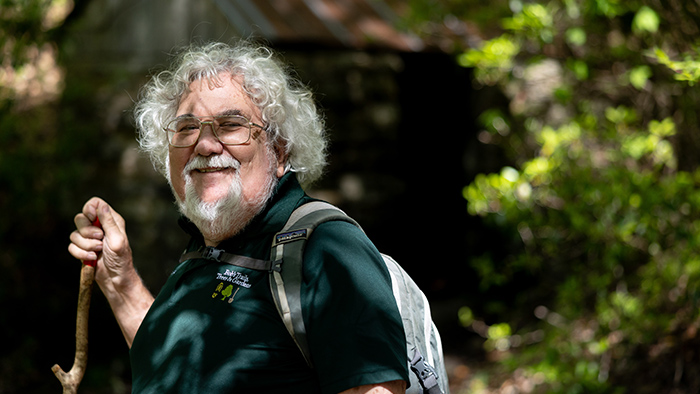
“I have been involved in trails in some shape, form or fashion all my life,” he says.
Richards, who grew up in Nashville and now lives in Powell, became interested in the outdoors playing in a nearby creek as a child and as a Boy Scout, earning a 200-mile hiking badge. At UT Knoxville, he majored in forestry, which is now housed in the School of Natural Resources in the Herbert College of Agriculture.
Richards entered the hiking scene at a good time. Interest in preserving land for recreation surged in the 1960s and 1970s, similar to how the New Deal’s Civilian Conservation Corps and Works Progress Administration efforts, in cooperation with the Tennessee Valley Authority, led to Tennessee’s first state parks in the 1930s and 1940s.
Richards’ early career benefitted from two state programs that mirrored national efforts: the Tennessee Scenic Rivers Act of 1968 and the Tennessee Scenic Trails Act in 1971. Both preserved natural areas and provided funding to hire workers. According to the Tennessee Trails Association, the state was the first to enact laws establishing a trails system within its parks.
“I was in the right place at the right time and knew the right person,” Richards says about the start to his career.
Booming Tennessee Outdoors
Being outdoors has again surged in popularity. The state has added 14 new parks during Gov. Bill Lee’s administration to bring the total to 63, with more than 1,100 miles of trails statewide. Then the Tennessee RiverLine, a UT Extension program in partnership with UT Knoxville and TVA, stretches 652 miles through four states so outdoor enthusiasts can take to trails on land and water.
Outdoor recreation economic impact in Tennessee increased nearly 20 percent from $13 billion in 2023 to $15.6 billion in 2024, while in the same period related jobs increased by more than 10,000 to more than 114,000, according to the most recent state statistics.
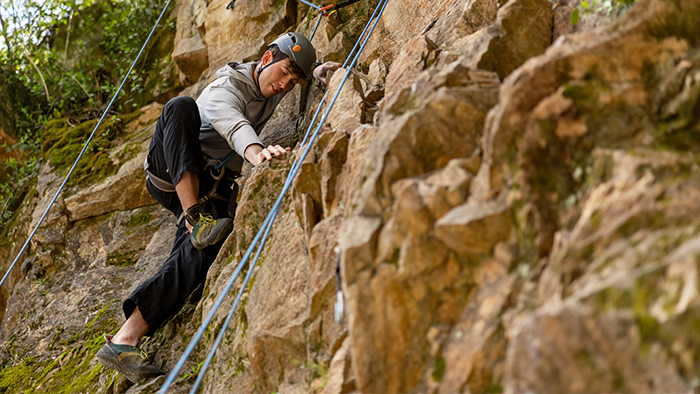
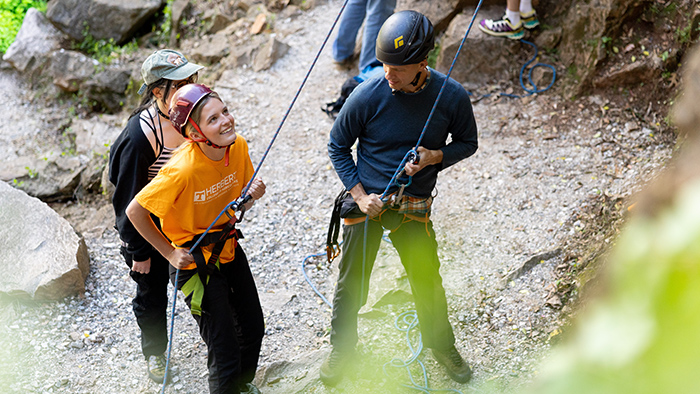
To meet the need, the Herbert College of Agriculture introduced the outdoor recreation and park management concentration within the forestry major. School of Natural Resources Professor Ryan Sharp is developing the program with an eye toward seeking approval for a standalone major. Across the state, UT Martin offers a minor in park administration.
“Tennessee is one of the leaders in economic output for outdoor recreation. It is really growing,” Sharp says. “We want to have opportunities for students to tap into that.”
The concentration prepares students for careers in parks and non-profits or even to create their own businesses, like Richards’. Classes discuss land conservation for recreation, cultural and historical interpretation, and how to manage sustainable trails that reduce erosion and compaction while curbing visitors from going off the trail. Two graduate students recently completed a thesis on off-highway vehicle use on trails.
Sharp and students participated this spring in analyzing a project along the Blue Ridge Parkway, in which they catalogued views or other experiences. The information will help visitors better plan their parkway visit, Sharp says. He has completed similar work in the Great Smoky Mountains, Joshua Tree and Acadia national parks.
Jobs await those who want to follow in Richards’ footsteps. The state needs more trail builders, especially to help in the new state parks, says Justine Cucchiara, director of the Tennessee Office of Outdoor Recreation. Cucchiara (Knoxville ’13, ’22) worked with Richards on a project when she managed Seven Islands State Birding Park outside Knoxville.
“You can’t just plop down a trail from point A to point B. There’s a science and art to it,” she says.
Learn more about outdoor recreation
How to Build a Trail
After finding land and creating a budget, Richards looks for features visitors want to see.
“You notice the steepness of the slopes, trees, wildflowers like trilliums in a nice forest,” he says. “You develop this feeling for where the trail is supposed to go over time by walking in the woods.”
Often trails follow paths created from old wagon roads or even ones made by deer, and, once the trail route is flagged, it has to be walked in both directions to ensure it is in the correct location, he says.
One of Richards’ favorite Tennessee paths follows the 284-mile Cumberland Trail, a project 50-plus years in the making that’s now its own state park and encompasses more than 40,000 acres, stretching from Claiborne County to Hamilton County.
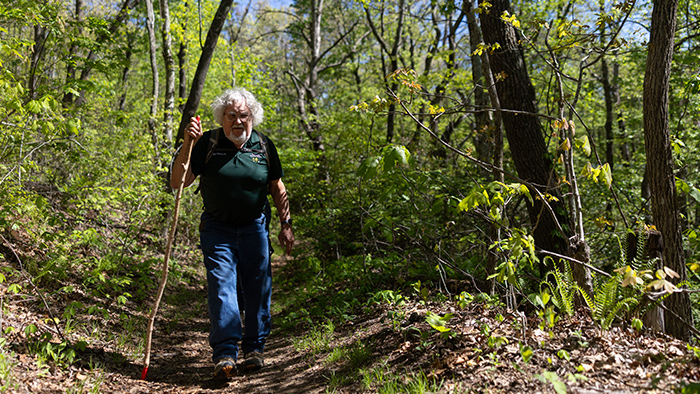
Black Mountain Trail near Crossville includes many of the attributes Richards looks for in a good trail: water, overlooks and interesting features like stone chimneys that belonged to long-gone homesteads and big sandstone boulders the size of RVs for climbing.
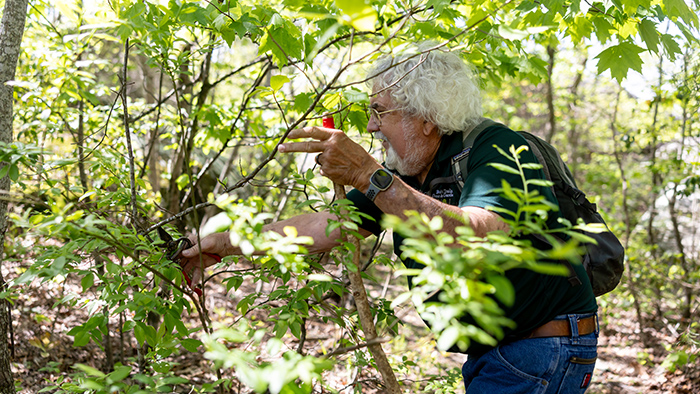
While hiking, Richards can’t help but critique the trail and do some maintenance. He whips out a pair of hand clippers to cut off small branches jutting into the corridor. He describes a trail like a tunnel with a walking area 6 feet to 8 feet wide and free of obstructions.
“Isn’t that better?” Richards says, as he snips eye-level branches.
Further along, water has eroded the narrow path, and hikers have worn away a parallel track to avoid the damage.
“Rule No. 1, water runs downhill,” Richards says. “Rule No. 2, get water off the trail.”
He points to a slightly raised area on the trail and a drain path flowing away downhill—called a reverse grade dip—that has been created to divert water but is now clogged with leaves.
After about half a mile from the sign pointing toward the overlook, the trail branches out toward a bluff. On this clear, beautiful day, eight people who rode to the trailhead on motorcycles enjoy lunch on the sandstone rocks overlooking the view. Far in the distance, a white billow of steam rises from the Watts Bar nuclear plant cooling tower, some 30 miles to the southeast. Beyond that, the faint outline of the Great Smoky Mountains rises in the background.
The bikers pack up their lunches and make sure to pick up any trash left behind.
“Have a great day,” one man says as he walks by.
“Every day is a great day on the trail,” Richards says.
Watch a video about trail construction on Bob’s Trails, Trees & Gardens website.