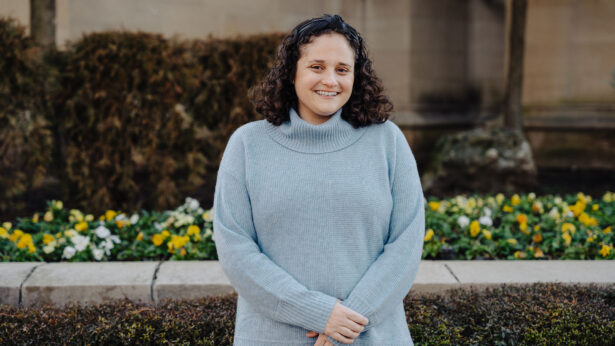
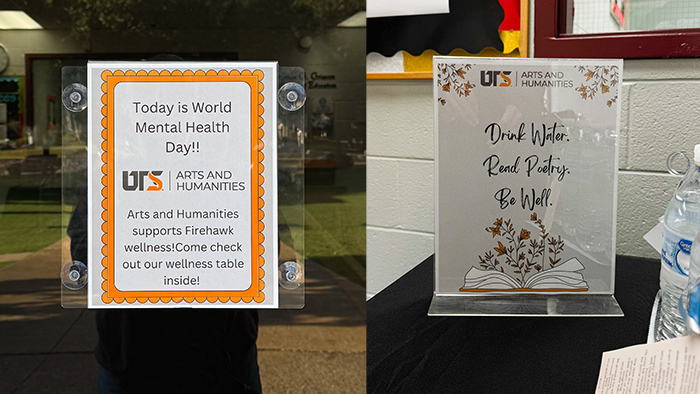
As is often the case with poetry, inspiration came suddenly to Jessica Conrad, chair of the School of Arts and Humanities at UT Southern. She had circled the date—Oct. 10, World Mental Health Day—on her calendar at the start of the semester, not realizing it would coincide with the final day of midterm exams.
“Everyone was feeling a bit rundown and stressed,” Conrad says. “It seemed like the perfect time to offer a small respite.”
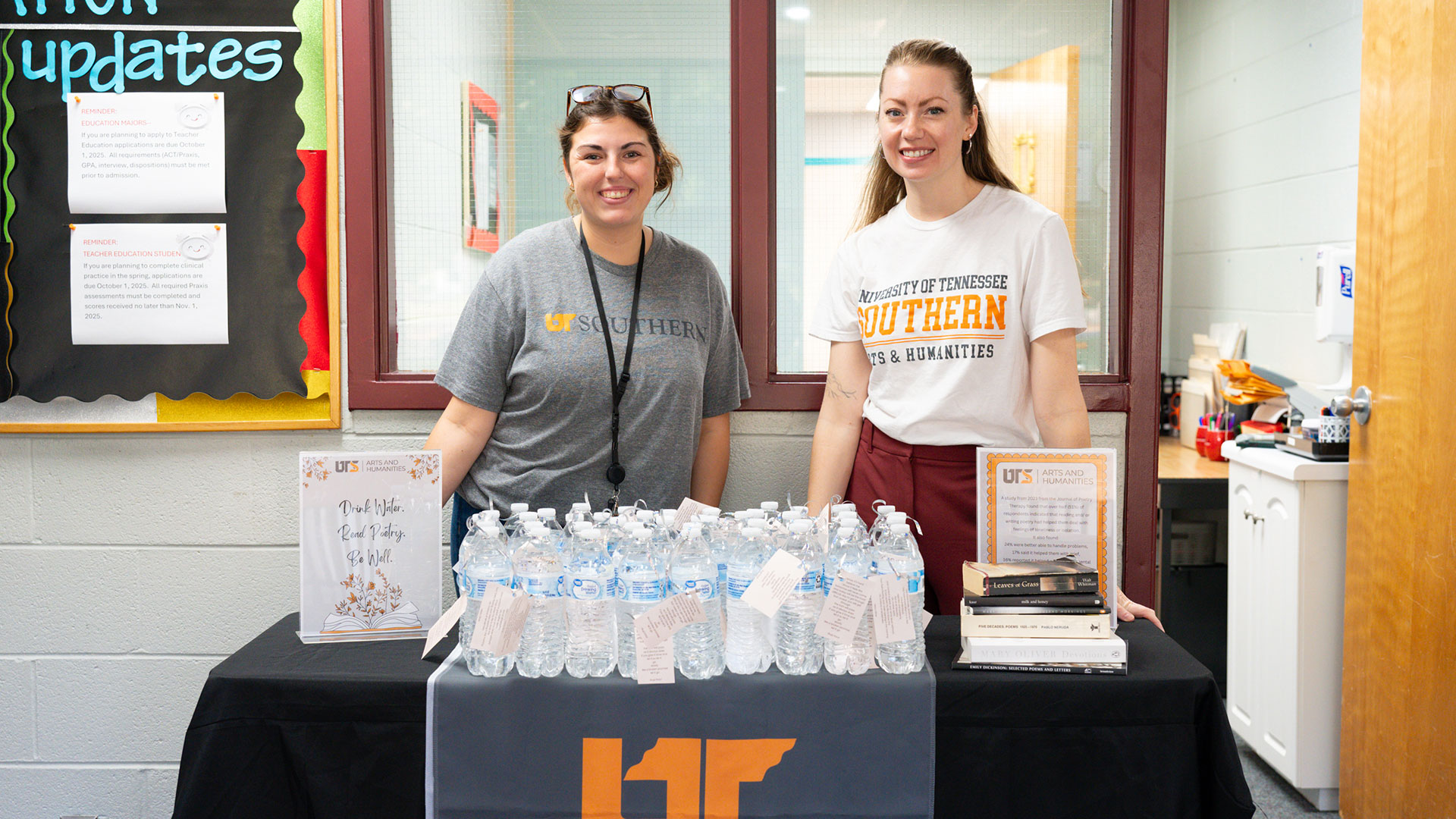
That morning, Conrad, an assistant professor of English on campus since 2024, and a colleague set up a table at the Johnston Center—the hub of academic life on campus—and made themselves hard to miss. What they offered was simple: a bottle of water with a printed poem attached that spoke to themes of hope, resolve and perseverance. Conrad called the event Drink Water. Read Poetry. Be Well.
“We know our minds and bodies work better when they’re hydrated,” she says. “There’s something really powerful about a small, packaged idea—like a song or a verse of poetry—that can mean so much in so few words.”
In a recent study published by the Journal of Poetry on the benefits of poetry during the COVID-19 pandemic, reading or writing poetry was found to help participants cope with loneliness or isolation, as well as with feelings of anxiety and depression—evidence, Conrad argues, that the positive effects of poetry resonate as much today as for previous generations.
Like any good teacher, she carefully considered poetry that might be most meaningful to students struggling with the challenges of college life. Among those she selected were a mix of classic and contemporary poets: Emily Dickinson (If I Can Stop One Heart From Breaking), Wendell Berry (Enemies), Maya Angelou (Still I Rise), Rumi (The Guest House) and Rupi Kaur (Let It Go).
She included several pieces by Mary Oliver, whose poem Wild Geese she encountered in a creative writing class as a college sophomore. “That poem stopped me in my tracks,” she recalls. “It wasn’t polished or academic, like I thought poetry was supposed to be. Her words felt real. They spoke directly to me.”
Poetry helps people appreciate the world around them, not just the world in their minds, Conrad thinks. Rather than a luxury for the elite, poetry, like the humanities in general, is fundamental for learning how to wrestle with silence and develop creativity, compassion and critical thinking skills.
If I can stop one Heart from breaking,
I shall not live in vain
If I can ease one Life the Aching,
Or cool one Pain,
Or help one fainting Robin
Unto his Nest again,
I shall not live in vain.
— Emily Dickinson
The School of Arts and Humanities has a mission to nurture “inquiry, imagination and innovation” through durable skills that allow students to contribute as engaged citizens wherever they are in the world.
While much of the student body is rooted in Giles County and northern Alabama, there is a growing contingent of international students. As the university expands its reach throughout Tennessee and beyond, its faculty has doubled down on wellness initiatives that show higher education isn’t about teaching students to check boxes to succeed but about cultivating balance, confidence and purpose.
Last semester, a Haitian student who read Langston Hughes’ The Negro Speaks of Rivers in one of Conrad’s classes wrote an essay about how it resonated with his own experience as an immigrant in a North American classroom. Another student, who stopped by the table during the event, grabbed a bottle with a Kaur poem before heading into an exam. After finishing, she returned to ask for another and stayed to flip through the poetry anthologies laid out on the table.
“If that was the only student who was moved, I think it was a success,” Conrad says.
Drink Water. Read Poetry. Be Well. is just the beginning of what’s possible when pairing wellness and the humanities. Conrad looks forward to convincing doubters, too. One cynic who passed by the table joked that getting 50 people to read a poem might be the hardest part of the experiment.
Conrad only smiled.
“I’m not naïve,” she says. “I’m sure some of the poems ended up in the trash. But I know others were read right there in the hallway.”
By the end of the day, all 80 bottles that she had set out were gone. Each one carried a powerful reminder for the students of UT Southern to drink, breathe and keep going.
“Hope” is the thing with feathers –
That perches in the soul –
And sings the tune without the words –
And never stops – at all –
And sweetest – in the Gale – is heard –
And sore must be the storm –
That could abash the little Bird
That kept so many warm –
I’ve heard it in the chillest land –
And on the strangest Sea –
Yet – never – in Extremity,
It asked a crumb – of me.
— Emily Dickinson
Source: THE POEMS OF EMILY DICKINSON: VARIORUM EDITION, edited by Ralph W. Franklin, Cambridge, Mass.: The Belknap Press of Harvard University Press, Copyright © 1998 by the President and Fellows of Harvard College. Copyright © 1951, 1955, 1979, 1983 by the President and Fellows of Harvard College.