It was a discouraging moment.
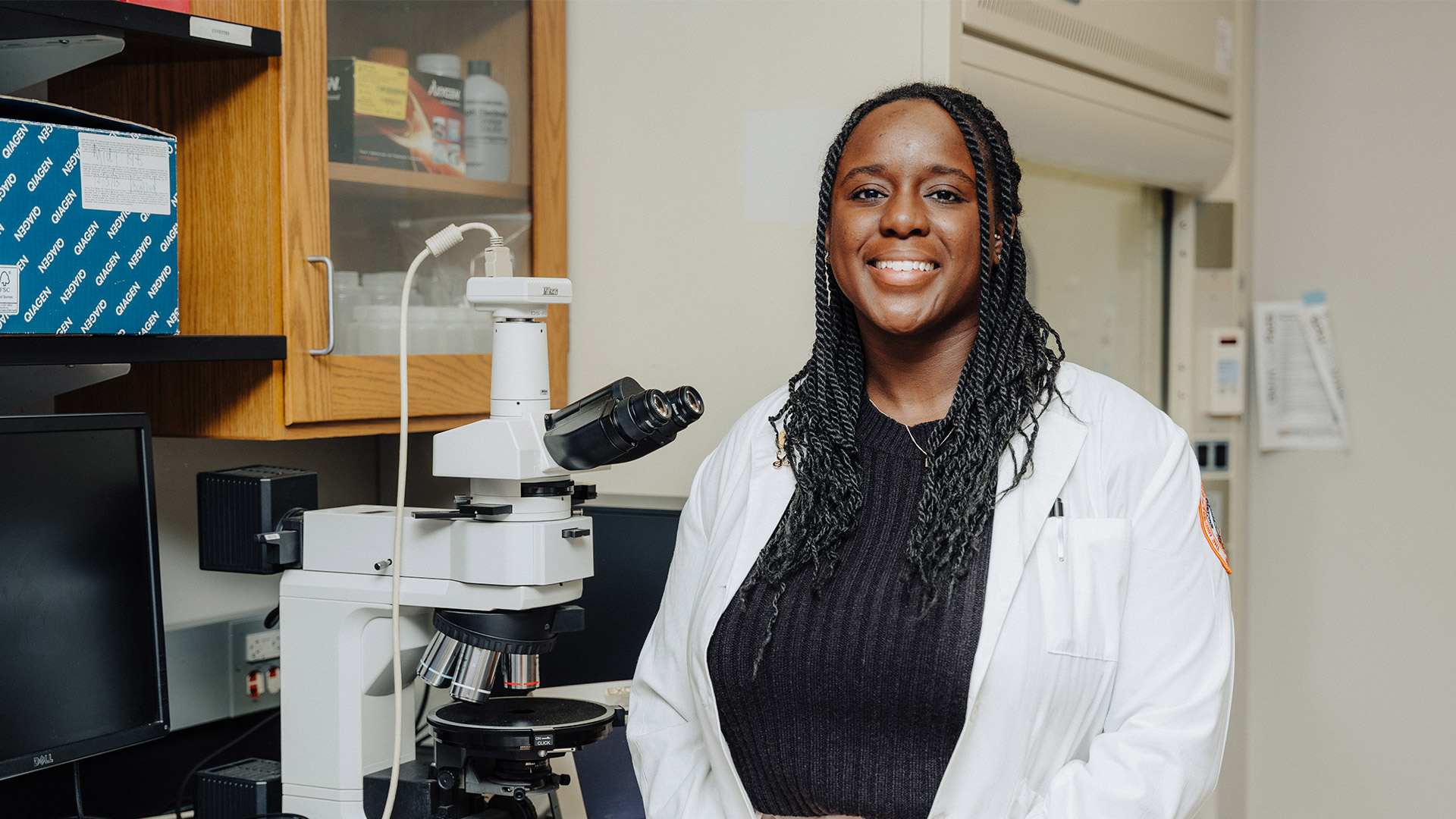
In 2019, Sarah Asemota (UTC ’16, HSC ’23) studied as a graduate student in Dr. Ramesh Narayanan’s lab at the UT Health Science Center. For her Ph.D. project, she had planned to examine how androgen receptor (AR) agonists could suppress tumor growth in estrogen receptor (ER)-positive breast cancer. But a high-profile paper on the same topic from Harvard University published first.
Rather than give up, she refocused her research on an equally important question: Could those same cancer cells eventually develop resistance to AR-targeted therapies?
A few weeks into the new experiment, Asemota noticed something strange under the microscope. After treating the cells with enobosarm, a selective AR modulator, for five to six weeks, they behaved and looked different. Their shape and structure had shifted in ways that hinted at a deeper transformation.
“I do this because I have questions. And when I find one answer, it usually opens the door to 50 more. That’s the beauty of science. That’s what makes it fun.”
—Sarah Asemota
“I remember thinking, ‘These don’t look like the same cells anymore,’” she says.
Not quite sure what to make of it, she turned to her mentor. Together, she and Narayanan began asking: What would it take to prove these were truly distinct cell lines now? The questions were big, and answering them would be expensive, especially for a graduate student.
But Narayanan didn’t hesitate. From the beginning, he had recognized Asemota’s insight, discipline and drive. With his support, she began laying the groundwork for a new line of inquiry, one that would deepen her understanding of tumor biology and establish her as a rising voice in driving cancer research towards clinical application.
The Research Pipeline
Breakthroughs in cancer research often make headlines when a new drug reaches the market or a clinical trial offers hope to patients. What’s less visible is the years, sometimes decades, of basic research that makes those milestones possible. Behind every breakthrough is a pipeline of early-career scientists, experiments that fail before they succeed and institutions willing to invest in ideas before their impact is obvious.
That pipeline starts with people like Asemota—graduate students, postdocs and junior faculty—who conduct foundational research that sets the stage for tomorrow’s therapies. But, for the pipeline to function, it needs support. Without funding, mentorship and access to research infrastructure, even the most promising discoveries can stall.
Asemota’s story is a case study in what happens when that support is in place.
When she observed the unusual cellular changes, the next step was a high-risk, high-cost experiment: analyzing the genetic activity of individual cells, specifically by reading the RNA instructions each cell was using, to understand how those cells had been reprogrammed. The price tag? Around $45,000 to $50,000, a daunting figure for a student-led project.
“Students are the pride of a mentor, more than their own discoveries.”
—Dr. Ramesh Narayanan
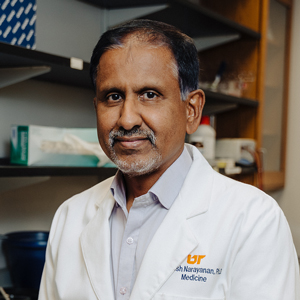
Fortunately, she had a mentor who understood the science and the system. Narayanan is a professor in the Division of Hematology and Oncology in the College of Medicine, Muirhead Endowed Professor of Pathology and the deputy director of the Center for Cancer Research. A senior cancer researcher with substantial federal and industry funding, he encouraged Asemota to apply for a National Institutes of Health (NIH) research supplement, an award that adds funds to an existing grant to support promising students. She got it. The supplement covered her salary and research supplies. But it came with a tradeoff. She had to give up her university scholarship. Yet the NIH award bolstered her curriculum vitae and moved the research forward.
The result was a study that led to a high-impact publication in Proceedings of the National Academy of Sciences.
“People forget Sarah was a graduate student,” Narayanan says. “Very few students here have had independent funding while earning their Ph.D.”
In five years, Asemota published seven papers, including three in Proceedings of the National Academy of Sciences and one in Cell Reports. Another is under consideration for The Lancet family of journals.
That one supplement helped launch a project that earned additional funding from the National Cancer Institute and revealed a critical insight: Under certain molecular conditions, AR agonists might not suppress tumors. They might help them grow.
A System that Works
Asemota’s success highlights how the right ecosystem nurtures emerging scientists. That includes access to funding, but also mentorship and institutional culture.
At UTHSC, faculty mentors are encouraged to create small, independent research projects for postdocs and high-performing students, giving them a runway to generate publishable data and apply for grants. Internal seed grants and pilot funding help bridge the gap between ideas and full-scale studies.
“UT Health Science Center is a fantastic environment for doing research,” says Narayanan. “There’s minimal teaching or administrative burden for researchers, so they can focus on the science.”
That focus is reinforced by infrastructure: the Office of Scientific Writing supports grant proposals; the Office of Research Development helps researchers identify funding opportunities; and nine subsidized core facilities offer everything from next-generation
sequencing to high-end imaging at a fraction of the cost.
“Without those cores, we’d be paying double,” Narayanan says. “That kind of support lets the science lead.”
Shaping Tomorrow’s Scientists
To Narayanan, mentorship isn’t a side job. It’s the cornerstone of his career.
“A mentor’s job is to ask: ‘What can I do to make sure this student has a prolific career?’” he says. “Students are the pride of a mentor, more than their own discoveries. If 10 of my trainees go on to lead labs, that’s the legacy that matters.”
For him, that legacy comes down to two things: preparing students for how slow and arduous a career in research can be and working behind the scenes to secure their opportunities.
“In science, you have to be okay with delayed gratification,” he says. “A project my lab started in 2014 just entered phase one clinical trials. It took more than a decade to get here, and we’re still far from approval. You have to be patient. You have to be persistent.”
That persistence gets harder when funding is scarce.
“In the 1990s, the National Cancer Institute funded one in three grants. Now, it’s about one in 11 or 12,” he says. “That doesn’t mean the other 10 were bad. They just didn’t get the chance.”
That’s why he sees part of his job as using his experience and connections to open doors for his trainees. “My job is to bring in the funding and offer direction,” he says. “The real work, the discoveries . . . that’s all my lab team. Everything we’ve accomplished in my lab has been because of them.”
Institutional Backing
At the institutional level, UTHSC leadership is committed to growing the next generation of researchers.
“Investing in trainees and early-career scientists is not just about building the future of science—it’s about honoring our responsibility to shape a research enterprise that is innovative and impactful,” says Dr. Jessica Snowden, vice chancellor for research. “If we want bold ideas and meaningful progress in defeating cancer and countless other health conditions, we must give emerging scientists the tools, mentorship and support to lead.”
That commitment is reflected in both policy and practice, from reduced teaching loads to investments in mentoring, internal funding and research support services. It’s a culture that empowers young scientists to take risks, generate data and compete for funding on their own terms.
The Why
Asemota received her Ph.D. in 2023 and is now completing clinical rotations on her path to becoming a surgical oncologist. As an M.D./Ph.D. in training, she believes the best way to connect lab discoveries to real-world impact is for scientists and clinicians to speak the same language and, ideally, be the same person.
“When you’re both a researcher and a doctor, you know which questions actually matter to patients,” she says. “You can design better studies because you’ve seen the gaps firsthand.”
Curiosity keeps her going.
“I don’t think we have to be pessimistic,” she says. “No matter what’s happening with funding, staying hopeful and staying curious is what matters. There are still problems to solve and questions that need answers.”
That spirit of inquiry drives her work.
“I do this because I have questions. And when I find one answer, it usually opens the door to 50 more. That’s the beauty of science. That’s what makes it fun.”