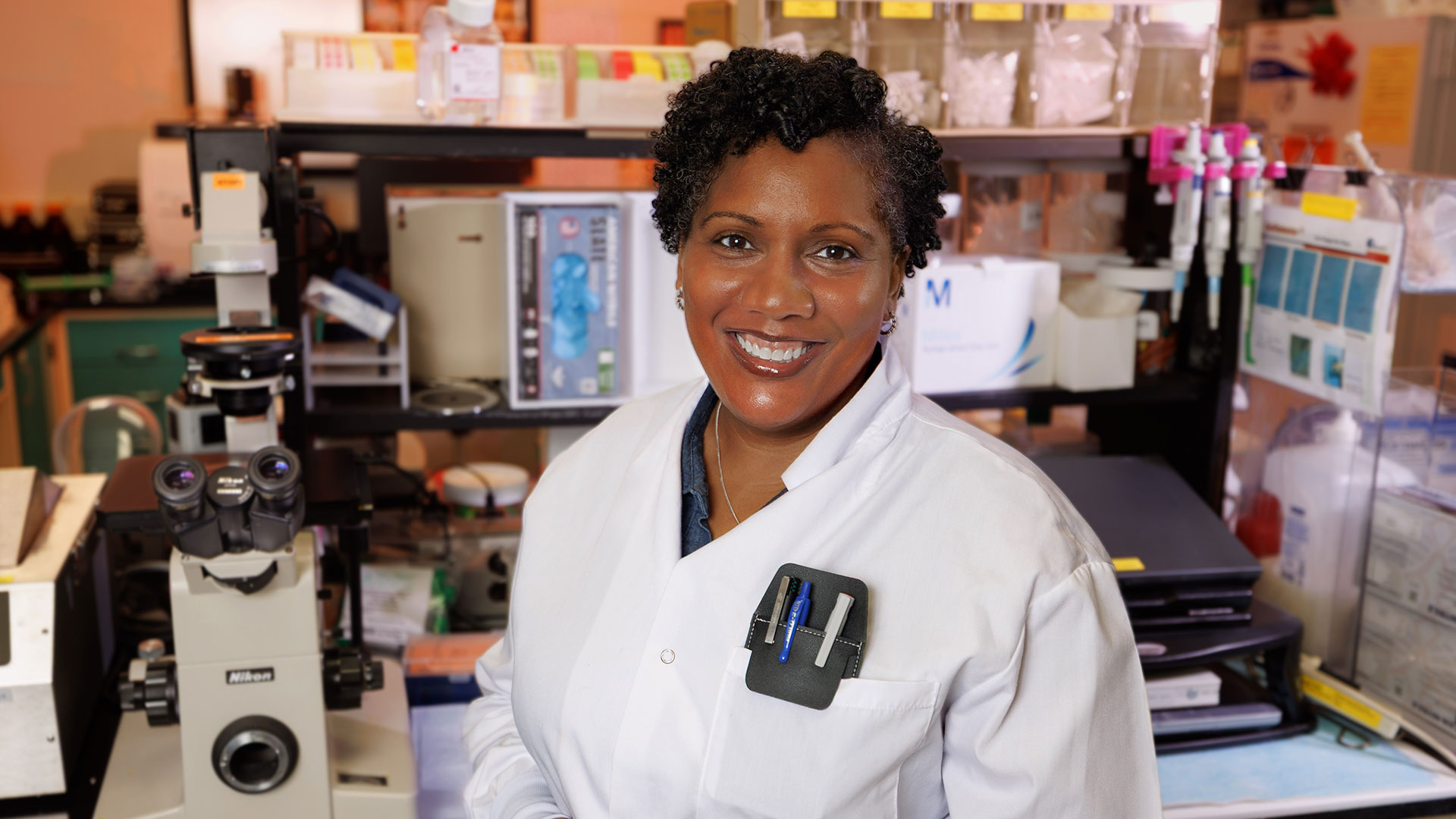
Once a cancer diagnosis was a death sentence, but people like Kelly Harris (Martin ’04) have provided patients with hope.
Harris works as a senior staff fellow in the Division of Biochemical Toxicology at the National Center for Toxicological Research, the official laboratory for the U.S. Food and Drug Administration in Jefferson, Arkansas.
In 10 years with the FDA, she has spent the past four focusing on identifying innovative approaches to cancer treatment, including repurposing existing drugs to improve outcomes for patients with difficult-to-treat cancers such as triple-negative breast cancer.
While studying at UT Martin, Harris knew that she wanted to be a doctor and conduct research. She received a workship, a type of scholarship that allowed her to work on campus as a biology assistant.
“Working in the biology labs gave me the opportunity to spend one-on-one time with faculty members who encouraged my curiosity and helped me understand the many different paths into research,” she says. “I realized there wasn’t just one route to becoming a scientist.”
While studying for her doctorate in biomedical science during her first year at Meharry Medical College, Harris decided to focus on cancer research.
“I went in thinking I was going to go the neuroscience route, but during my first-year lab rotations, when I got to the biochemistry and cancer biology department, I realized it was a much better fit for what I wanted to do,” she says.
While at Meharry, Harris did research on obesity and its problems. Aramandla Ramesh—who became her mentor—wanted to incorporate how a high-fat diet influences cancer initiation and progression.
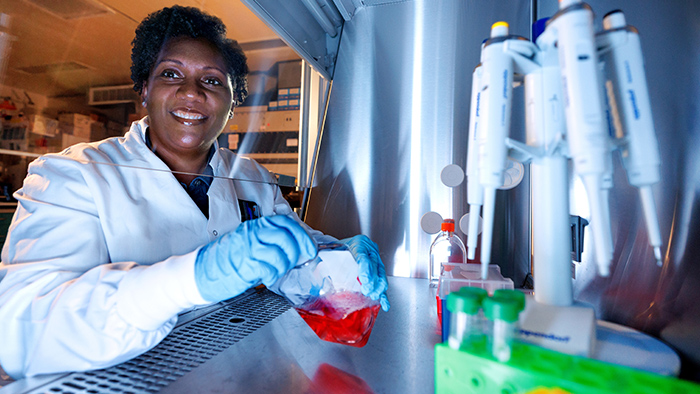
“When I realized I could build on the background I already had while learning new techniques, that’s when I decided to move into cancer research instead of neuroscience,” she says.
Harris credits Ramesh with her arrival at the FDA laboratory. The University of Alabama at Birmingham had recruited Harris for a postdoctorate position. Then she interviewed at the National Center for Toxicological Research, where leadership offered her a post-doctorate position immediately. She told Ramesh about the offer.
“He said, ‘That’s where you’re going. Call UAB and tell them that you’re not coming.’ I said, ‘Wait, they spent two years recruiting me,’ and he said, ‘I don’t care. You’re going to the government. This is where you need to go’—which was true. It gives a nice middle ground between academia and industry.”
Her current research focuses on a drug for triple-negative breast cancer, a subtype that lacks the hormone receptors and HER2 protein targeted by many existing therapies. Without those targets, treatment options become much more limited.
“That’s one reason why patients often require more aggressive therapies, such as chemotherapy or radiation,” she says, “I’m focusing on finding better treatment alternatives.”
Cancers have their own unique structures from person to person based on lifestyle, even if it’s the same type, she says.
“Before these last four years, I was focused a lot more on the actual genetic aspect of cancers. Many genetic mutations occur naturally throughout life, while others may result from inherited factors or environmental exposures.”
When Harris began at the Food and Drug Administration, she studied mutations that take place before they become cancer.
“Your body is usually very good at clearing out cells that are harmful or out of sync with normal function,” she says, “but you’d be surprised how many mutations can develop even in tissue we consider normal. Some of those mutations remain dormant indefinitely, while others accumulate over time and may eventually contribute to cancer development.”
At the research center, Harris uses nextgeneration sequencing.
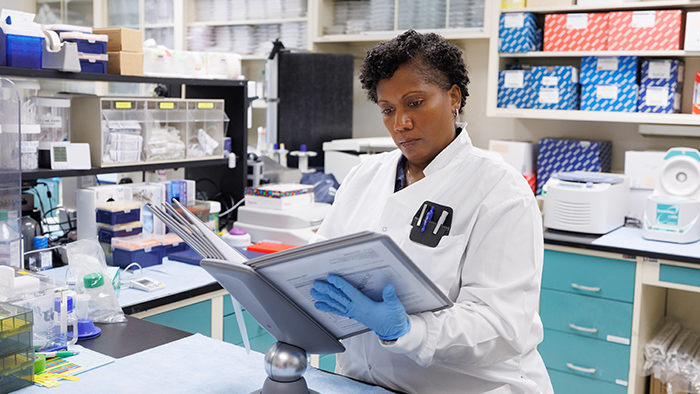
“I can take DNA and sequence it and understand what genes are being affected in the body,” she says.
Harris studies non-cancerous tissue samples from different points in a patient’s life from their early 20s to their late 80s, then analyzes the DNA to see what mutations might be present to cause cancer.
“Before these last four years, I was focused a lot more on the actual genetic aspect of cancers,” Harris says.
Many people can remember a time when a cancer diagnosis was a death sentence with a short fuse. Today, especially with early detection, treatments can extend people’s lives years longer.
“The evolution has been pretty mind-blowing,” Harris says. “Even working in the field, you can be surprised by what has been developed in just a month’s time.”
No longer compartmentalized, cancer research now includes scientists, physicians, social scientists and other disciplines working together.
“Now, we have more collaborative teams that are doing these research projects, which helps us where I can incorporate not just what’s happening but what other factors could be causing it,” she says.
At the National Center for Toxicological Research, Harris says she helps the public.
“What I do is for the betterment of the population that’s out there. It’s not just doing the research and publishing the manuscript and somebody will read it. We’re focused on making a difference; whether it’s helping inform policy or studying ways existing drugs might be used in new ways, our goal is to improve public health.
“It’s a great experience to be able to do that because we are behind the scenes all the time, but there are a few glimpses where you get to see that your work is actually making a difference. That kind of helps keep you going.”