On one of the first sunny days last Spring, virologist Colleen Jonsson sat outside her office building at the UT Health Science Center, face up to the sun.
“You have to get your sun,” she says to a passerby.
A professor in the Department of Microbiology, Immunology and Biochemistry and director of the Regional Biocontainment Laboratory at UT Health Science Center, Jonsson learned the value of self-care like this the hard way.
A world-class “virus hunter,” she has researched the hantavirus in the jungle of Paraguay and done antiviral drug discovery at several academic and government labs across the country on respiratory syncytial virus (RSV), influenza, H5N1 (avian influenza), West Nile virus, HIV and encephalitic alpha-viruses, including the eastern equine encephalitis virus.
In early 2020, she faced off against SARS-CoV-2, the COVID-19 virus, leading UT Health Science Center’s COVID-19 Research Team. The next few years of around-the-clock lab work, uncertainty as the virus spread and changed, rushed media interviews to educate the public, and testing and research to understand and contain the virus left her with more than the black quilted vest embroidered with the UTHSC COVID-19 team logo that she wears proudly to this day.
They left her with the realization that, if she did not begin to care for herself, she would not be able to fulfill her passion for the research that helped her care for others.
As she has done her entire career when faced with a problem, she began the search for a solution. She found her answer in the practice of yoga, eventually earning a 200-hour certification, enough to teach others. Now, she aspires to share the practice that has changed her life with students and other health care professionals in the hopes of changing theirs.
‘It Hit Me in the Face’
“I really have never worried about my stress,” she says, though over her 30-year career in academia, she has worried about the stress on her students. “During the pandemic was probably the first time when it sort of hit me in the face really hard that I also had stress.
“I was coming to work and stressed about this situation, plus all my students volunteered to work during the pandemic, so then I was worried about them and just worried about everything in general. That created a huge amount of stress that I had never experienced before. And that’s when it just hit me that I need to adapt to this.”
She was not alone.
According to the American Medical Association, 62.8 percent of physicians had at least one manifestation of burnout in 2021.

The U.S. surgeon general’s advisory addressing health worker burnout in 2022 cited a survey of more than 1,100 health workers during the summer and fall of 2020 that found 93 percent experienced stress, 86 percent had anxiety, 76 percent suffered exhaustion and burnout, and 41 percent felt lonely.
“I ended up at the doctor’s office, and he had to tell me that I was not dying, but I was stressed,” Jonsson recalls. “And I was just like, what am I going to do? It took me a few months, and then I remembered that, pretty much over my whole life, I had been off and on with yoga. And I thought, well, maybe if I started doing some yoga, that would help.”
At the time, the world was still in virtual mode. She started doing online classes from a studio in Memphis.
“It was enough for me to slow down and just be back with my body again, I guess, to be physically present, mentally present, without worrying about the lab,” she says. “It took me away.”
Over time, Jonsson began to try different types of yoga—slow flow, Yin yoga (holding poses for several minutes) and meditation.
“I knew that I wanted to learn how to be quiet with myself and to just sit and ask, ‘How do I feel today?’ To have self-perception, and that was sort of my goal with it, that I would be able to start scanning my body and say, ‘Where am I holding my tension today?’ Then I need to step back and say, ‘Hey, I don’t need to respond like that. It’s going to be fine; we’re just going to deal with it.’”
Recently, she has begun to study mindfulness-based stress reduction (MBSR), which cultivates awareness and acceptance of the present.
When told she looks much more relaxed these days, she responds, “Yeah, I mean, we’re not in a pandemic, but I think it shows.”
Jonsson hopes to design a way to incorporate yoga, meditation and mindfulness into the curriculum, initially in the College of Medicine, her department home.
“Stress is a good thing because it motivates you to change, right? But when you’re in school, you just want to be motivated to work,” she says. “What they’ve shown with MBSR is that students who partake in MBSR actually do better in their exams and their coursework.”
It’s Become My Playtime
When Jonsson rises between 5 a.m. and 6 a.m., she has a short meditation followed by her physical practice that lasts between 30 and 45 minutes. Another short meditation-type practice follows.
“What I found is, learning from everybody else helped me develop my own little practice in the morning, which I enjoy a great deal,” she says. “To me, it sets me for the day. I find it grounds me for the day. I think that’s the biggest thing I get out of yoga is I feel very grounded. I feel like I am here right now for everybody, and I’m not somewhere else, and I’m not worried about something else, and I don’t try to do everything at once.”
She is not concerned with perfection in her practice.
“At my age, I don’t try to worry about my exact shape or how I’m doing it or anything like that. I just see how my body’s feeling and move into the pose and adjust as needed. It’s become my playtime.”
The crucible of COVID-19 led Jonsson to one of her most important discoveries.
“Life will always provide you with opportunities to challenge yourself and your ability to handle what it’s throwing at you,” she says. “Perhaps, when we’re younger, we don’t appreciate that life will consistently provide you challenges where you will pause and you will say, ‘I don’t know if I can make it through this.’ And, eventually, you have to let go.”
The Professor’s Practice
Colleen Jonsson likes to keep her yoga practice simple. “It’s my little time in the morning. Some people might like the evening wind-down, but I really like having just that early time where I can just explore and have fun.”
She says she is experimenting with the movement, but these are some of her favorite poses and why she loves them:
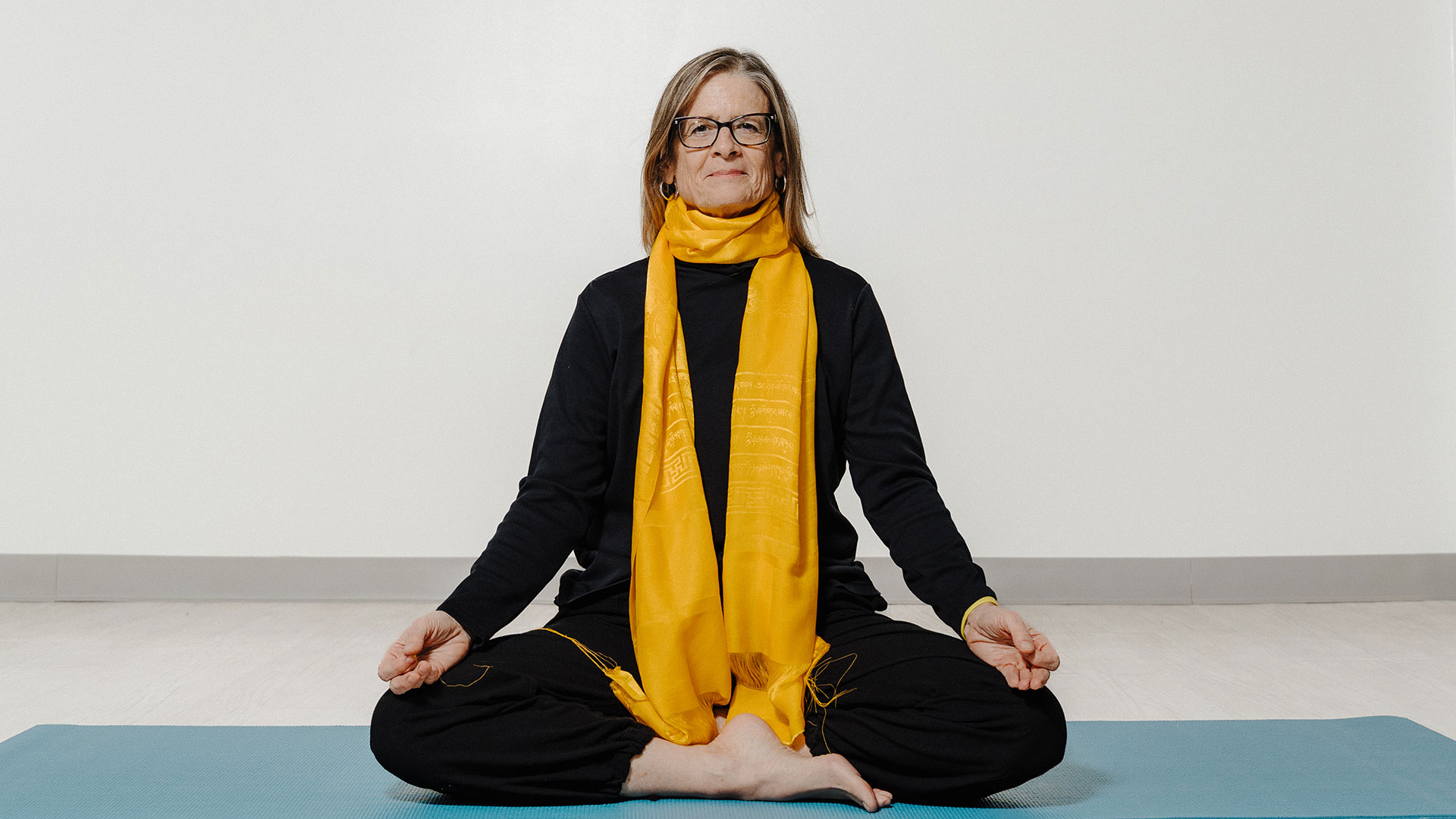
- Easy Pose (Sukhasana): Seated pose, good for beginners and for breathwork. “My go-to pose to take a pause.”
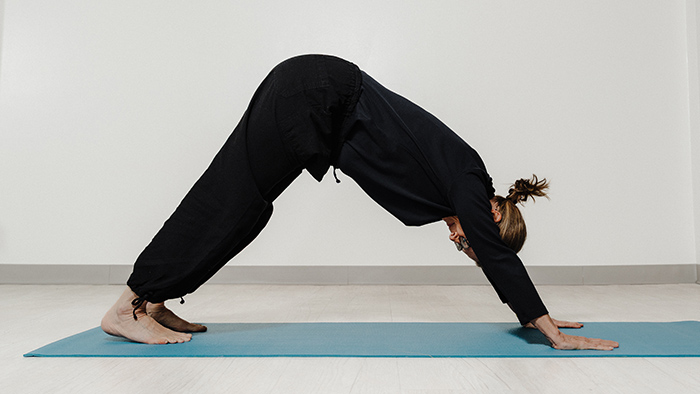
- Downward Dog (Adho Mukha Svanasana): Full-body stretch. “My go-to pose to wake up.”
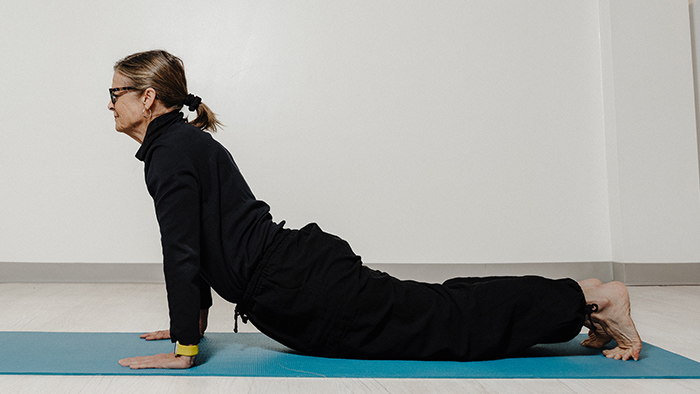
- Upward-Facing Dog (Urdhva Mukha Svanasana): Spine stretch, strengthens arms and shoulders, improves posture, “My go-to pose to wake up, along with Down Dog.”
- Warrior One (Virabhadrasana 1): Strengthens legs and stretches hips. “My place to get into the entire body.”
- Warrior Two (Virabhadrasana 2): Strengthens quads, shoulders, core. “My place to balance and get into the entire body.”
- Garland Pose (Malasana): Deep squat, stretches hips, groin, ankles. Strengthens legs and core. “Where I find a sense of play, childhood.”
- Child’s Pose (Balasana): Releases stress, resting pose. “Where I rest.”