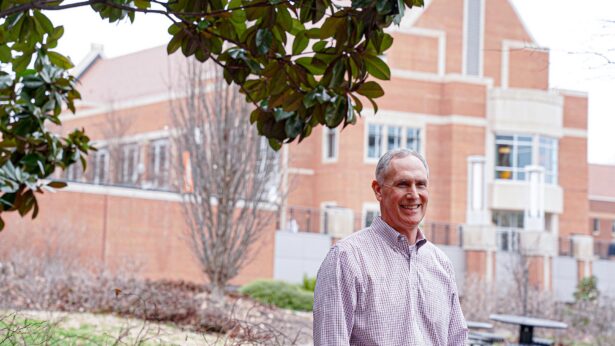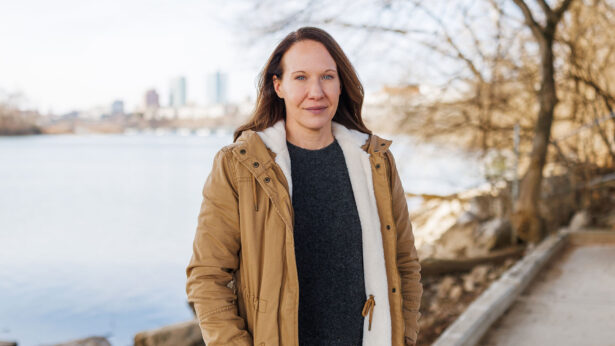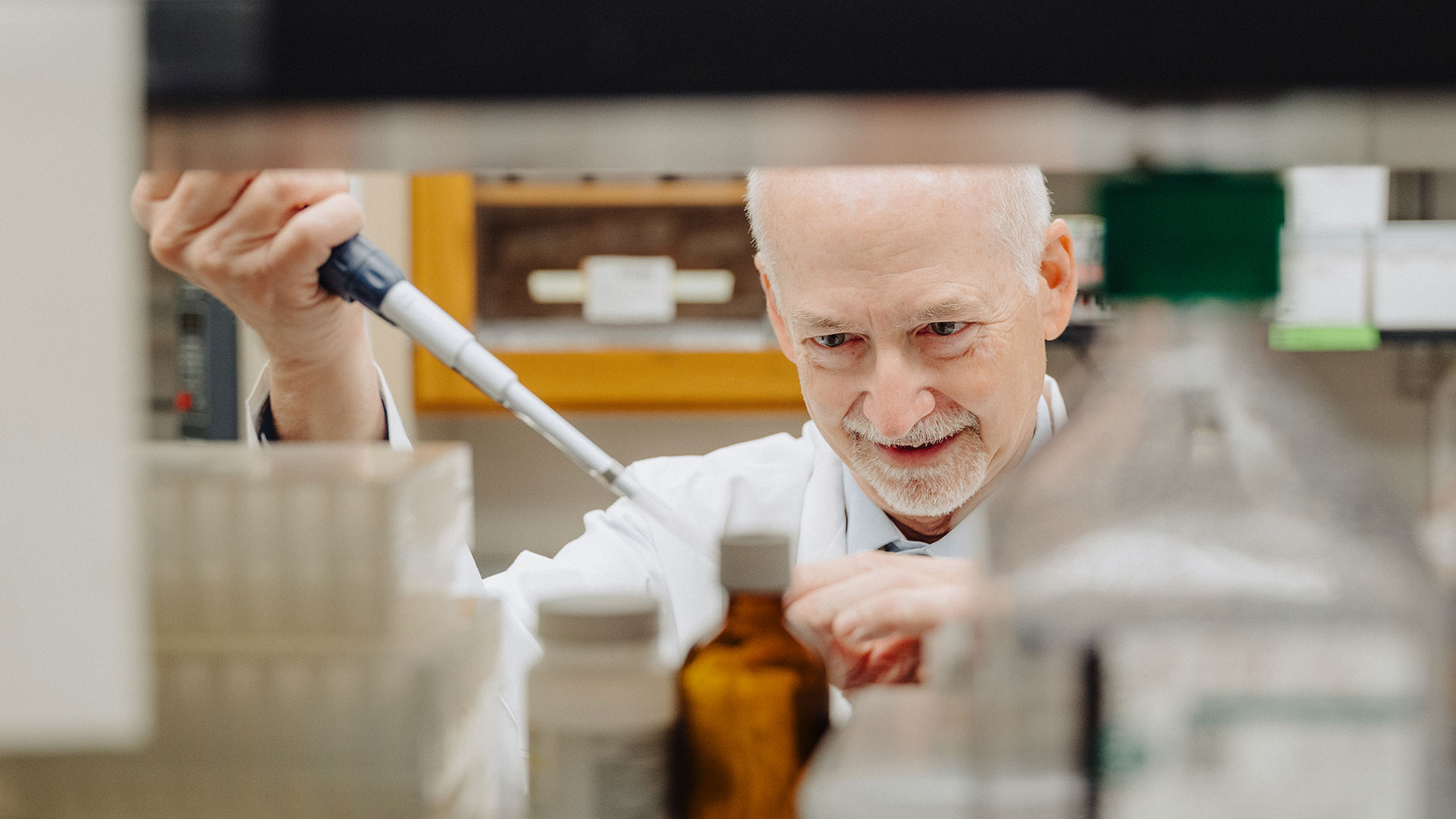
In the mid-1980s, Lawrence Pfeffer and Daniel Nachsen were young assistant professors, collaborators and friends working at research institutions across the street from each other in New York City: Pfeffer at Rockefeller University and Nachsen at Cornell University Medical College.
Then one became ill.
“It was very depressing when I found out that he had brain cancer because he was such a young guy,” Pfeffer says. “The only way I can describe it, he got klutzy in the lab. I noticed that he had difficulty doing fine motions with his hands, these measurements that you had to have very good hand-eye coordination to do. That kind of went away all of a sudden.”
The time from Nachsen’s diagnosis of glioblastoma to his death was only a few months, Pfeffer recalls.
He honored Nachsen by giving his daughter the middle name, Danielle. He also made a vow that has changed the course of his life and stands to do the same for the lives of others with the same diagnosis as his friend.
Pfeffer has dedicated the bulk of his career to trying to improve treatments for glioblastoma, the most common malignancy of the brain.
A few months ago, Pfeffer, who holds a doctorate in cell biology and is a Distinguished University Professor at the UT Health Science Center, and fellow UT Health Sciences researcher Duane Miller were awarded a patent on a new drug molecule with the oblique name of IV 129 to treat glioblastoma.
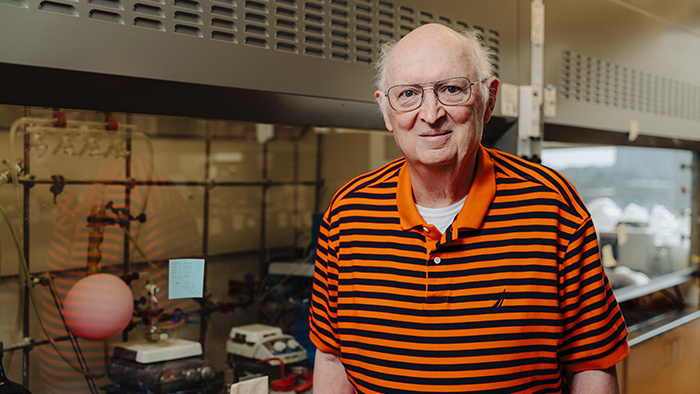
Pfeffer has worked with Miller to develop and refine the drug, which targets a molecular pathway to enhance the sensitivity of glioblastoma to temozolomide, the primary therapeutic approach to the disease. The current treatment for glioblastoma involves a targeted combination of temozolomide and radiation, which has been shown to work for a while to inhibit existing tumors but then may stop working as dormant cancer stem cells rev up and multiply, he says.
“It’s really finally recognition that we’ve come up with a discovery that is important,” Pfeffer says.
Pfeffer holds other patents on drug discoveries, as does Miller. This one, though, is special. Updated generations of the newly patented drug are in the works and show promise of not only increasing the sensitivity to the treatment but also inhibiting cancer stem cell formation and then killing cancer stem cells.
The hope is the patent and further discoveries on this drug may attract investors, who might eventually help move it into clinical trials.
“Our goal is not to make money out of this,” Pfeffer says. “Our goal is to be able to help patients with glioblastoma.”
The Road to Discovery
Several years ago, Pfeffer, along with Miller, who is a professor emeritus in the Department of Pharmaceutical Sciences in the College of Pharmacy, developed the first version of a small molecule to enhance the sensitivity of glioblastoma to temozolomide. It was an enhanced version of an inhibitor originally produced by Pfizer.
“We discovered that, if you treat with this drug in the presence of something like temozolomide, it greatly enhanced the ability of temozolomide to kill glioblastoma cells,” Pfeffer explains. “Duane Miller and I worked together to develop new molecules based on this original small molecule inhibitor called PFI-3 that was made by Pfizer, and we improved the function of it and the specificity. It’s much more potent than the Pfizer drug.”
In 2022, Pfeffer contemplated retirement and thought he would finish his longtime quest with some wins but never the big one: a better drug to battle chemotherapy resistance in glioblastoma.
However, his colleagues in the UT Health Science Center for Cancer Research convinced him to apply for one more grant from the National Cancer Institute (NCI) to continue his research. NCI awarded Pfeffer $2.56 million over five years to identify and target the molecular pathways that will enhance glioblastoma’s sensitivity to currently approved drug therapies.
He was back in the hunt. The patent is a result.
“Dr. Pfeffer’s work reflects the kind of bold, creative science that drives real progress against some of our most devastating diseases,” says Dr. Jessica Snowden, vice chancellor for research. “By rethinking how we target glioblastoma at its biological core, his research brings us closer to the lifesaving therapies patients and families are waiting for.”
‘I Love Science’
The recent patent was for the first generation of the inhibitor. However, Pfeffer says he’s working on new refinements with Miller, who’s a researcher, colleague and friend like Nachsen all those years ago.
“It’s a perfect marriage,” he says. “We have complementary expertise.”
Miller, the medicinal chemist, designs the molecules while Pfeffer, the cell biologist, tests them.
“We want to figure out if it has good pharmacological properties, if it has good properties, that it goes to the brain, stays in the brain a long amount of time, gets well absorbed by the brain. Those are things that we still have to work out. That’s why we keep making new inhibitors.”
“Larry got me interested in working on glioblastoma because it is such a devastating disease in humans,” Miller says. “We continue our search for even better agents to treat this brain cancer. We feel these new agents merit preclinical development.” Pfeffer’s latest grant runs through 2028, and his plan is to retire in December 2028 or early 2029.
Click to Expand Images
“I hope, by that time, we can develop the most potent drugs that we can with great pharmacological properties that we can use in patients and test in a Phase 1 clinical trial with some angel investor who is willing to put in the money for us to get there,” he says.
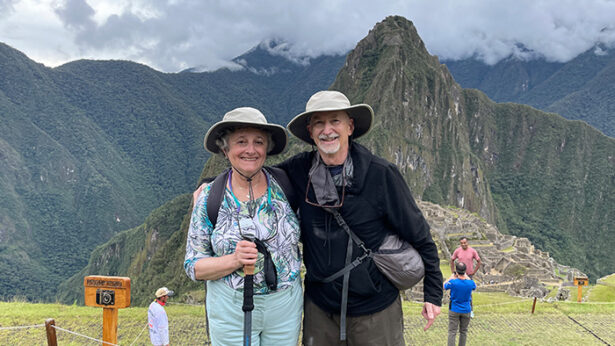
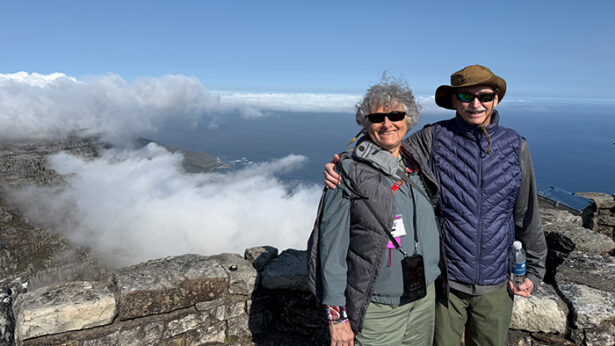
At that point, Pfeffer hopes to fulfill his wanderlust, which he and his wife, Susan, a retired researcher who worked in his lab, have had time to do only on holidays and vacations.
“We’re just wild adventurers,” he says. “We went to Antarctica. I went on a submarine to the floor of the Antarctic Ocean in Australia.” On another trip, he took a helicopter ride over Victoria Falls in Africa, even though he admits to being afraid of heights.
Until retirement, his big adventure lies in the lab.
“I love science,” he says. “I really love discovery.” And he has a message for those diagnosed with glioblastoma: “There is hope. We’re coming up with new discoveries here at UT Health Science Center to help people who’ve kind of lost hope. If we can extend their lives by several years without this drug causing any problems in patients, then this would be great, and maybe we can extend their lifespan by a lot.”
From Bench to Bedside: It Takes Fortitude
Let’s say a researcher has an idea that could be the next big breakthrough in health care.
It’s just the first step in a long process that will take patience, tenacity, experimentation, test after test and unwavering faith in the idea’s value and what it could bring to humankind.
In other words, drug discovery is not for the faint of heart.
“It’s a Herculean task,” says James Parrett, the UT Research Foundation (UTRF) interim vice president for the UT Health Science Center. “It’s an iterative process. It’s a slow process. You have to be prepared to pivot.”
UTRF helps move discoveries from the laboratory toward real-world use and encourages entrepreneurship among researchers.
Consider this timeline from UTRF for the drug discovery process:
- Step 1: Research and Development: In this initial phase, scientists explore a problem and make a discovery that could help patients. This work is usually funded by grants, donations and universities.
- Step 2: Innovations: In this phase, the research has resulted in new molecules or the discovery of a new use for a medication.
- Step 3: Evaluation: This is the analysis phase. Researchers test and retest the discovery to ensure that it is safe and works as expected. “All of these phases, there is no fixed timeline,” Parrett cautions.
- Step 4: Intellectual Property Protection: Here is where the patent comes in. The patent indicates the research is a novel concept and has commercial potential. It also protects the intellectual property. However, there is a long road ahead. Various versions of the original drug candidate may emerge as research progresses, making additional patents necessary.
- Step 5: Marketing: Once the drug candidate shows potential and is patented, it must be marketed to possible commercial partners, drug companies or startups, with resources to move its development forward.
- Step 6: Licensing: After a commercial partner is found, the drug candidate is then licensed to the company that takes responsibility for the next stages.
- Step 7: Product Development: This process includes securing approval from the Federal Drug Administration and involves meeting preclinical requirements and then clinical trials. “The vast majority of drugs that go into clinical trials don’t wind up being approved,” Parrett says.
- Step 8: Public Use: If all the hurdles are cleared, the drug makes it to the marketplace.
“It’s a long road, but it’s very rewarding,” Parrett says.