For many children with developmental delays such as autism spectrum disorder, diagnosis does not occur until preschool or early elementary years.
One faculty member at UT Chattanooga is contributing to research aimed at understanding those early developmental differences.
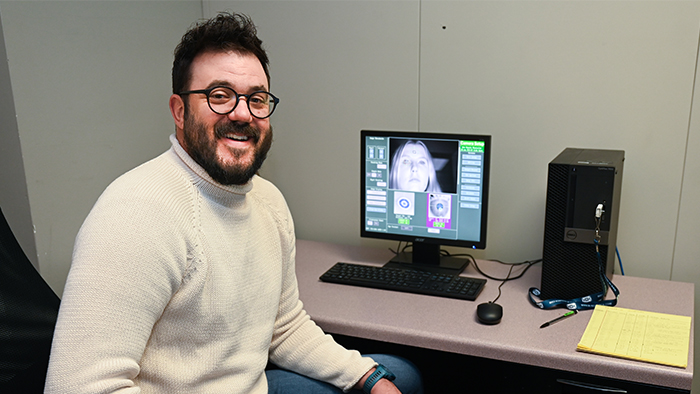
Bret Eschman, an assistant professor of psychology and director of the Visual Memory and Attention Development (VMAD) Lab, studies how the brain develops during the earliest months of life.
His work focuses on attention, memory and how infants process information by using eye-tracking technology as a noninvasive way to understand what happens inside developing brains.
Eschman says he fell in love with eye tracking early in his career. Introduced to the technology during his graduate studies at Missouri State University, he carried that experience to UT Knoxville, where he earned a doctorate in 2019.
“That’s the first time I began working with infants in terms of eye tracking and asking research questions around that,” Eschman says. “One of the big projects that I worked on there is trying to quantify something called the working memory capacity, which is a really important cornerstone of general cognition that is online pretty early in life.”
Working memory capacity, he says, can be reliably measured around 5 months of age and is an important future indicator of cognitive function: think mathematics, reading and language.
He then pursued postdoctoral research at Florida International University, where he studied how infants pay attention to sights and sounds simultaneously.
“That work has helped researchers better understand mechanisms of typical development and how early differences in attention may be relevant for conditions such as autism spectrum disorder,” Eschman says. “The goal is to understand risk pathways, not necessarily to diagnose.”
Now at UTC and in the VMAD Lab, Eschman continues to build on his studies, working with children and their families as he conducts research on attention and memory across development as part of a National Institutes of Health-funded project that brings together labs across North America.
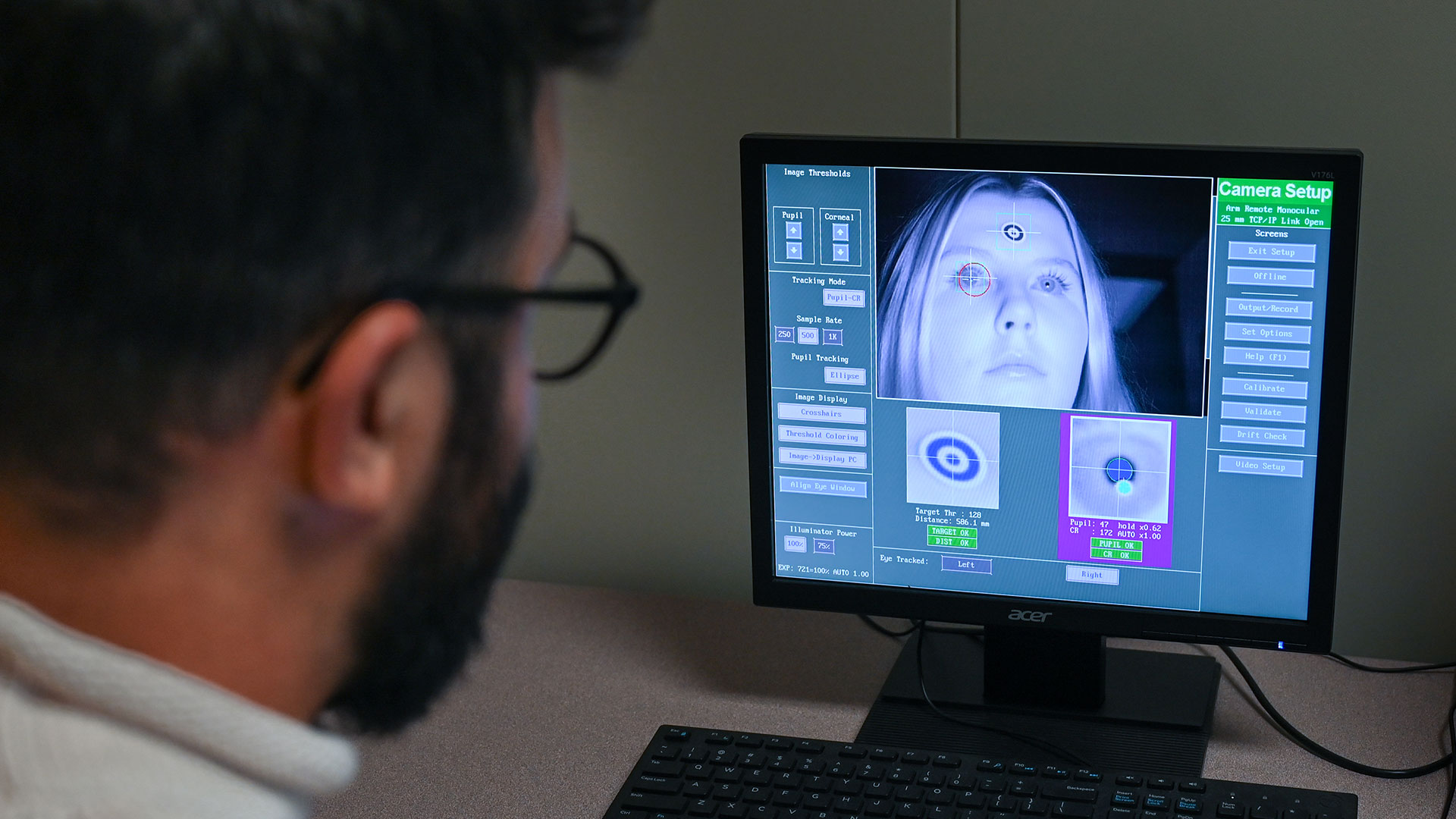
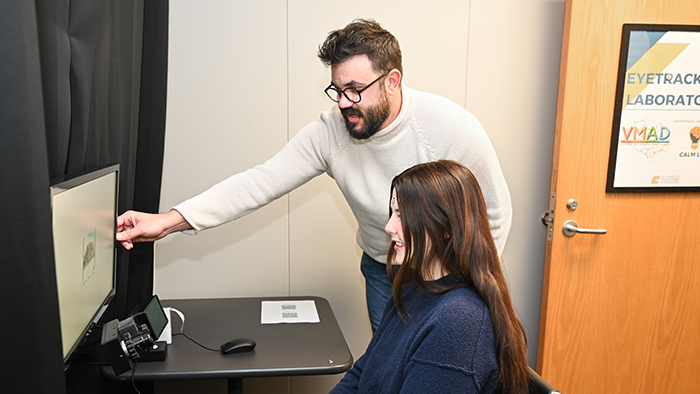
Much of his work involves infants and children too young to complete traditional tasks or follow verbal instructions. Eschman and his collaborators rely on eye tracking to understand how attention and memory develop. By recording where a child looks, how quickly attention shifts and how long they stay focused, researchers get a “glimpse under the hood,” according to Eschman.
“Eye tracking provides a powerful behavioral window into brain development,” Eschman says. “Because we know a great deal about how visual and attentional systems are organized in the brain, patterns of eye movements can tell us a lot about underlying cognitive processes, even when we are not measuring neural activity directly.
“From a developmental perspective, eye tracking allows us to study attention systems supported by distributed brain networks, including how frontal systems involved in attention control interact with sensory systems early in life.”
Much of the work follows children over time—beginning in infancy—and can provide context for understanding later outcomes related to language, learning and social development.
“We have data from these kids from 3 months of age,” he says. “We have them at yearly intervals.”
“From a developmental perspective, eye tracking allows us to study attention systems supported by distributed brain networks, including how frontal systems involved in attention control interact with sensory systems early in life.”
—Bret Eschman
The team has worked with the same children for more than three years, allowing researchers to track their development and identify when early differences begin to appear.
“Then we can go backwards and look at their data that we collected to see at what point did these deviations in responding to these different tasks predict their outcome,” he says.
Early findings, Eschman says, show that certain attention patterns may predict later outcomes, such as autism spectrum disorder, earlier than researchers once thought.
“What we’re finding in some of the preliminary data is that patterns of attention at around 12 months are associated with later outcomes at the group level,” he says. “These are probabilistic signals, not diagnoses, but they appear earlier than researchers once expected.”
The work changed significantly during the COVID-19 pandemic, when in-person lab visits were no longer possible.
“During COVID, we had to make a big change with the way we were keeping data, so we obviously couldn’t bring babies and their parents into the lab,” Eschman says.
Instead, Eschman and his collaborators shifted the research online, using Zoom and webcam recordings to collect data from families at home.
“We actually developed computational models that allow us to extract specific eye movement metrics from webcam recordings collected at home,” Eschman says. “While these methods do not replace laboratory eye tracking, they allow us to recover comparable measures with known limitations when in-person testing is not possible.”
Over time, refined models improved the reliability of specific eye movement measures compared to traditional lab-based data.
The project continues to evolve as well.
“The work we’re currently doing now with graduate students is a little bit more attention-based and not as much developmental,” Eschman says. “We’re doing a lot of low-level cognitive work that includes processes like inhibition and planning and how they relate to factors such as stress, intelligence and dyslexic symptomology.”
He says many graduate students enter the lab with varying levels of experience and are unsure of what they want to pursue. It usually doesn’t take long for them to shape their own projects and research.
Bailee Smith, a 2025 UTC graduate, helped Eschman with research focused on the relationship between executive function and intelligence.
“I’ve been able to help design tasks, create projects and really build the lab alongside Dr. Eschman. That independence has been invaluable,” says Smith, who earned a master’s degree in psychological science.
It’s an approach Eschman emphasizes in his work.
“A lot of them take extreme ownership of that, and they really kind of make it their own,” he says.
Daily Interaction Matters
Parents often ask Bret Eschman, UTC assistant professor of psychology and director of the UT Chattanooga Visual Memory and Attention Development Lab, how to help their children’s brains grow.
It’s a simple answer: Daily interaction matters more than toys, apps or programs.
“You do not need special tools,” he says. “Your time, your voice and your attention matter most.”
His advice for parents:
- Babies learn best face to face. When a child sees a parent’s mouth and expressions and hears their voice at the same time, the brain links sights and sounds. Those links support attention, memory and language. Talk while your child can see you.
- Follow your child’s attention. If your baby looks at a toy, a pet or a book, talk about that thing. Name it. Describe it. Then pause. Let your child respond. You build attention control by respecting where it is, not by pulling it elsewhere.
- Slow the pace. Young brains need time to process information. Pause after your child vocalizes or gestures. Give space to respond. Fast, nonstop stimulation overwhelms developing systems and reduces learning.
- Use infant-directed speech. Speak with a slightly higher pitch and a clear rhythm. Slow your speech without oversimplifying. This type of baby talk is a natural teaching signal. It holds attention and helps children understand words.
- Repeat experiences. Read the same books. Sing the same songs. Play the same games. Repetition helps the brain learn patterns. Predictable routines support memory and focus.
- Let effort happen. Do not solve every problem right away. Allow brief frustration. Step in when needed. Small challenges help build self-control and problem-solving skills.