
Dr. Jessi Gold, the UT System’s first chief wellness officer, says wellness should sit at every table, not just in health offices.
“Maybe to some people I’m like that annoying Jiminy Cricket on the shoulder,” she says, “always reminding them, ‘Hey, what about wellness?’”
That persistent nudge shapes her approach. She treats wellness as practical, everyday work. Not an optional perk.
Gold, a psychiatrist and faculty member at the UT Health Science Center who still sees patients, says people who want to improve their wellness should start small.
“How do I feel?” she suggests as the first question everyone should ask themselves. “No one else is checking on us all of the time. Subtle differences are really hard to notice. We don’t notice until it interferes with life, school or work.”
What are the Eight Dimensions of Wellness?
The Substance Abuse and Mental Health Services Administration’s Eight Dimensions of Wellness frames the multifaceted nature of wellbeing. Each dimension represents an important aspect of health. Here’s a brief exploration of each dimension.
EMOTIONAL
Coping effectively with life and creating satisfying relationships.
ENVIRONMENTAL
Good health by occupying pleasant, stimulating environments that support well-being.
FINANCIAL
Satisfaction with current and future financial situations.
INTELLECTUAL
Recognizing creative abilities and finding ways to expand knowledge and skills.
OCCUPATIONAL
Personal satisfaction and enrichment derived from one’s work.
PHYSICAL
A healthy body.
SOCIAL
Developing a sense of connection, belonging, and a well-developed support system.
SPIRITUAL
Expanding our sense of purpose and meaning in life.
That simple check-in acts as an early warning sign. Once a person identifies a feeling or pattern, it can be mapped to the Substance Abuse and Mental Health Services Administration’s eight dimensions of wellness to frame the bigger picture. The eight dimensions are physical, emotional, social, spiritual, occupational, intellectual, financial and environmental.
“If you have any issues in one dimension,” she says, “it’s going to affect others in sort of a domino, kaleidoscope-interacting way.”
Thinking about wellness in this way, she says, improves student retention, workplace performance and overall health.
“Wellness is often seen as something fluffy like yoga or pizza parties,” she says. “While those things are part of it sometimes, I want people to understand that wellness has an evidence base.”
That evidence includes social support, sleep habits, purposeful activity and simple grounding techniques such as deep breathing or progressive muscle relaxation.
“Social support is one of the most protective things that we have,” she says. “You just need a person you can talk to and trust.”
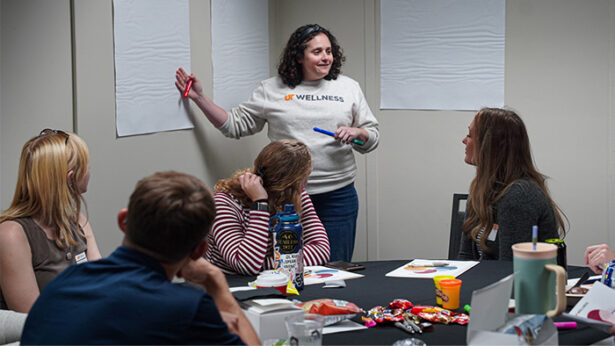


Click to Expand Images
Gold carried those ideas from conversation into action. Since stepping into the chief wellness officer role, she has launched a range of efforts to make wellness a shared, systemwide priority.
She leads student and staff groups focused on mental health, funds new ideas through campus mini grants and hosts rotating wellness events that tackle topics like social connection and substance misuse. Together, these initiatives strengthen services, build community and turn wellness into everyday practices.
But Gold says wellness starts with individual habits. With that in mind, she stresses repeatable, positive practices over dramatic fixes. Start by checking in daily by using an app, a sticky note or a morning ritual. She recommends building a toolbox of coping skills.
“I treat coping skills like hobbies,” she says. “You’ll do them if you like them.”
If one strategy fails, try another. Connect with a trusted person for support. Try a brief grounding exercise, like noticing what you can see, touch or hear, or taking slow, mindful breaths to bring attention back to the present moment. Or practice gratitude by focusing on positive moments instead of dwelling on negatives.
Gold acknowledges that virtual care has expanded options and should remain part of the mix. But she also notes that in-person visits sometimes reveal behavioral clues a screen can miss. When looking for therapy, she recommends searching directories, comparing fit and remembering that a better match can improve outcomes.
“If you don’t love your therapist, you might be able to do better,” she says.
Her ultimate measure of success goes beyond individual coping. She wants cultural change. Gold says success means her role at UT becomes unnecessary: not because problems vanish but because wellness becomes a routine part of decision making at the university and in the daily lives of faculty, staff, students and the communities UT serves.
“I almost become obsolete,” she says. “I’ve done my job so well that everyone else is doing the things that I’m doing.”
Dr. Jessi Gold’s Recommendations to Aid Everyday Wellness
- HEADSPACE, CALM: Mindfulness and sleep applications for your phone or device. Both apps offer free tiers. Calm includes guided “bedtime stories” that many people find helpful for better sleep.
- HOW WE FEEL: a free, science-based journal for tracking emotions to improve emotional awareness and well-being. Simple daily check-ins help users notice subtle changes before they become a crisis. Use the app or a sticky note; just keep doing It.
- NAMI (National Alliance on Mental Illness): Plain-language information and family resources. NAMI’s materials help readers learn symptoms, find support groups and start conversations.
- PSYCHOLOGY TODAY THERAPIST SEARCH: A searchable directory to compare therapists by location, specialty and insurance. Gold calls it Bumble for therapists. Find a fit that feels right.
- SLEEP HABIT BASICS: Put your phone away at night, use an old-school alarm clock if needed and protect a consistent bedtime routine. Gold says better sleep often shows the biggest return on well-being.