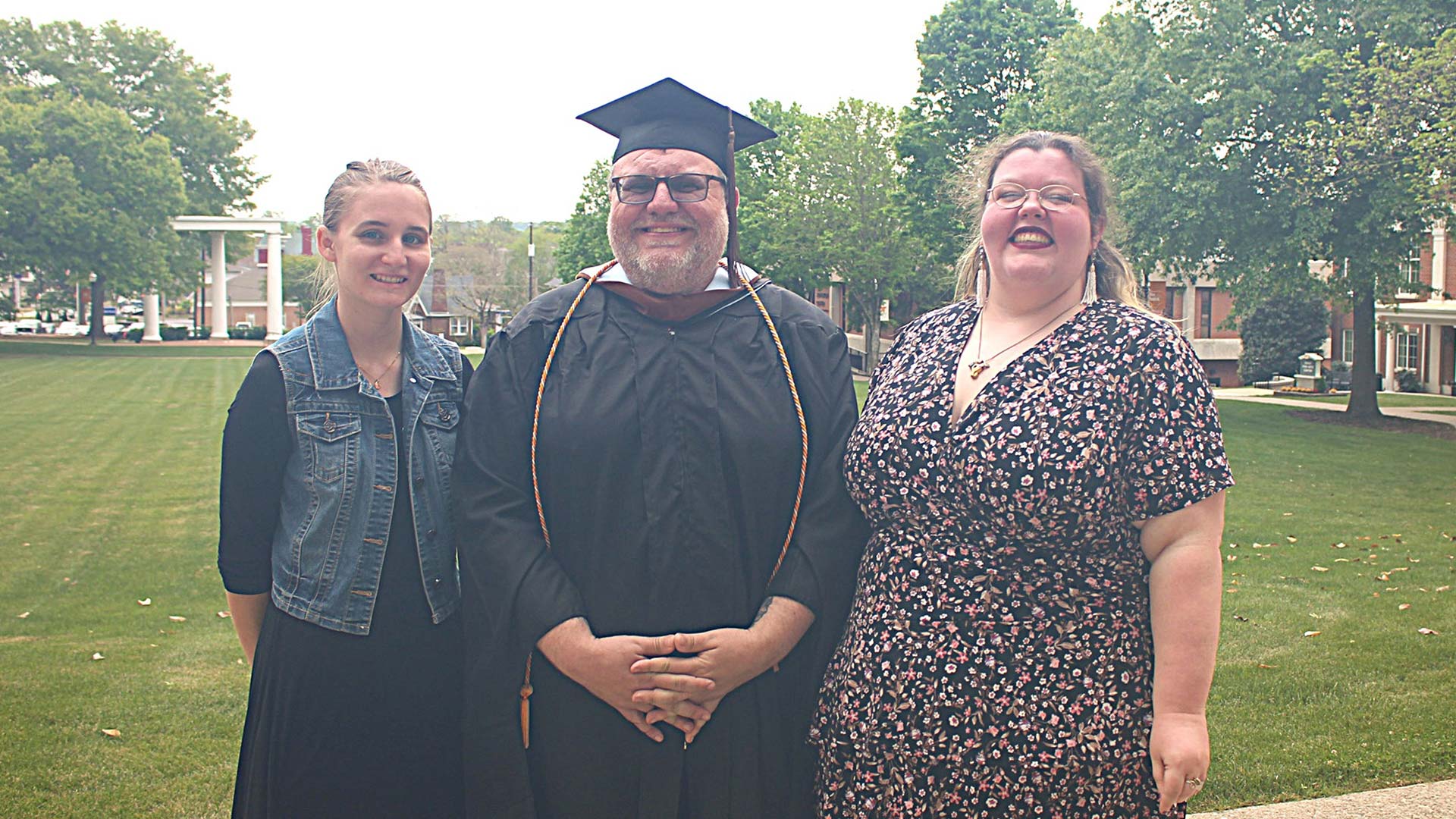
Recent graduates Fayth Dennis and Clare Jones share the spotlight as the first two students to complete UT Southern’s dramatic arts concentration within its newly configured fine arts degree.
The journey was a learning experience—not just for them but also for UT Southern’s faculty who continue refining the curriculum.
The Show Must Go On

Before Martin Methodist College became UT Southern in 2021, the school offered a theater degree. Faculty moves shelved the degree for a while. Now it’s returned as part of a still-evolving program that allows students to concentrate in music, visual art or dramatic arts.
“We continue to rethink our (fine arts) program in a way that will let our students get the full classroom experience while also working very closely with their professors,” says Jessica Conrad, assistant professor of English and chair of the School of Art and Humanities. “Our core mission is to provide transformative student experiences. Fayth and Clare had that through working so closely with Barry (Rich).”
Rich, instructor of English and theater, says he tries to expose dramatic arts students to all facets of theater work, while also showing them how the training can help them in a wide array of careers outside the theater, too.
Each semester, dramatic arts students must complete an hour of hands-on theater work, be it acting on stage, helping with costumes, building sets or something else. Then, as a capstone project, they must take a major role in staging a production.
Leading the Cast
Dennis, of Bell Buckle, came to then-Martin Methodist College in 2018 and completed her associate’s degree at UT Southern in 2022. She then joined UT Southern’s staff as the director of Criswell Hall, a women’s residence hall.
In 2023, when she learned the university was offering a fine arts degree with a dramatic arts concentration, she re-enrolled to finish her bachelor’s degree.
Dennis wants to teach dramatic arts at the high school level and then eventually go to graduate school to become a college drama teacher.
“One of the main reasons I want to teach is the growth you see in each student,” she says. “They have to figure out their character’s mannerisms, how they show emotions. They have to ask themselves, ‘How do I differentiate from the character?’”
Click to Expand Images
Jones, of St. Joseph, wants to work in, or maybe even run, a community theater. She hopes to find an apprenticeship program through a local community theater.
As the only two dramatic arts majors, the two young women have spent a lot of time together. They became good friends, despite their differences.
Jones says she’s “an introvert—100 percent,” while Dennis describes herself as “very outspoken, an extrovert.”
“The way you see the world and the way I see the world are very different,” Dennis says, “but that’s what made it fun.”
Capping Off Their Studies
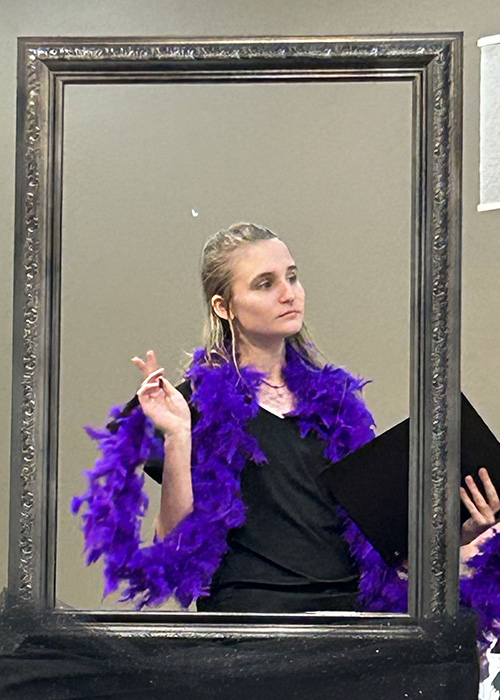
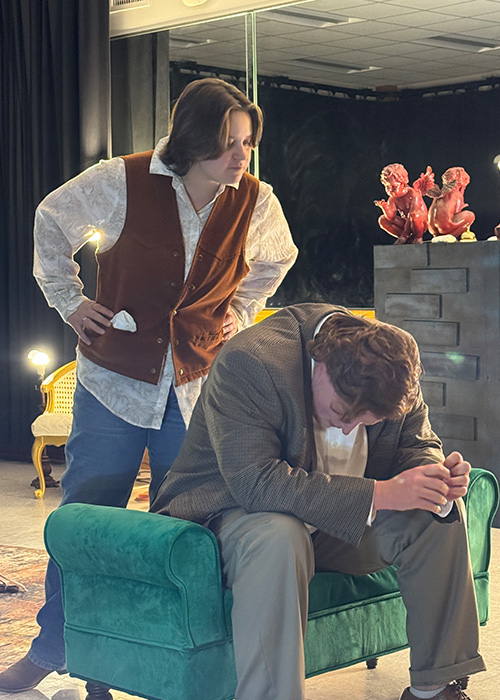
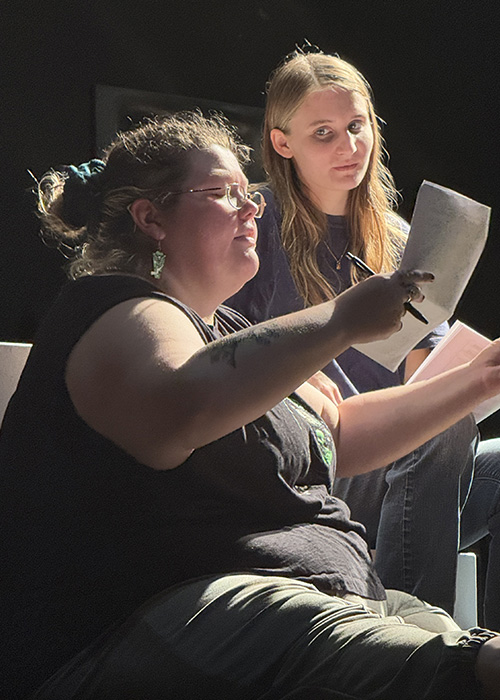
For their capstone projects, Dennis and Jones chose to direct productions. That meant developing a unique concept for their productions, visualizing costumes and sets, holding auditions and running rehearsals.
Rich says directing teaches many skills: “You have to have a sense of time, exercise your interpersonal skills. There’s so much that goes into it besides what happens on the stage.”
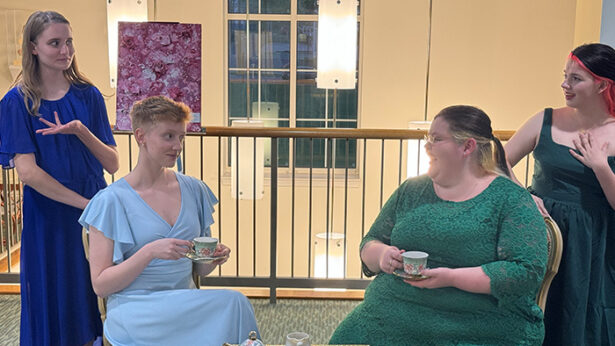
Dennis chose to direct one of her favorite plays: Jean-Paul Sartre’s No Exit, an existentialist tale about three ne’er-dowells who die and land in hell, which is portrayed as a hotel room with a locked door.
And, just as the work commenced, an ice storm hit, and her cast lost a week of rehearsals. In addition, each actor got sick at least once, missing additional rehearsals.
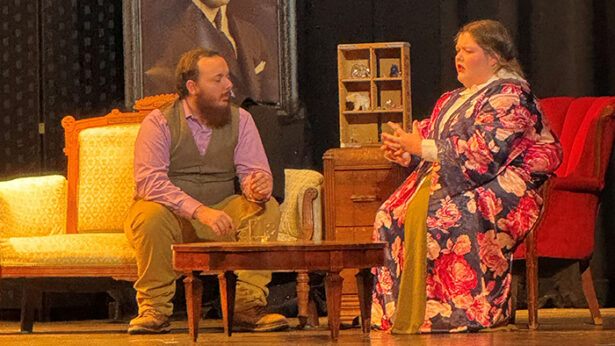
Jones directed Tennessee Williams’ The Glass Menagerie, a play she’d studied in an acting class.
“Every one of my cast and crew had other lives—work or other regularly scheduled events,” she says.
Without her full cast on hand, she couldn’t rehearse the show from start to finish. She had to break rehearsals down by scenes, focusing on who was there on any given day.
Working with individual actors “ultimately made me so much better talking to people,” she says.
Applause, Applause, Applause
Despite the obstacles they encountered, Dennis and Jones brought their shows to the stage for multiple performances.
“I thought they did wonderfully,” Rich says. “I saw them both grow, learning from the mistakes they made and the stumbles they had and finally seeing them enjoy watching this thing they had a role in come alive.”
Rich says both young women have what it takes to succeed in theater-related careers—or whatever they choose.
And Conrad is confident that UT Southern’s fine arts program, though still a work in progress, is scripted for success.
“Our world needs the arts, and if we don’t have the arts, we as a human species lose our capacity for being human,” Conrad says. “This is how we thrive, connect, express ourselves.
“The arts and, in particular, theater—when you are the instrument—is the perfect way for students to grow and become who they are most capable of being.”