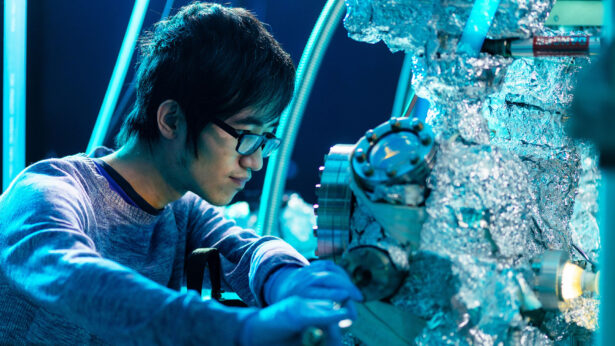
As the world changes, quantum technology opens possibilities we could only imagine a generation ago. We’re entering a new technological era powered by quantum physics.
Within the next decade, I believe quantum concepts will become a standard part of secondary school education worldwide. My role is to ensure that educators and decision-makers understand the promise of quantum technology and why preparing for it matters.
Universities need to move now to avoid being left behind, and luckily, at UT Chattanooga, we have a head start. Through the university’s partnership with EPB, the Chattanooga power and fiber company, we have permanent access to a commercial quantum network.
Working in UTC’s quantum networking lab on campus, I can conduct experiments and test theories under real-world conditions using EPB’s commercial fiber infrastructure. I share sketches of the network configuration we need, and the EPB team responds quickly, providing technical support before and during experiments. That collaborative spirit makes Chattanooga unique and enables us to advance quantum networking research.
My work focuses on quantum networking and timing synchronization using this infrastructure. The technology is no longer theoretical—it’s here. With single-photon detectors, miniature atomic clocks and other advanced research equipment, we are helping lay the foundations for tomorrow’s quantum technologies.
This work isn’t just for postdoctoral researchers or doctoral students. Every one of our experimental papers includes undergraduate students as co-authors. Students who gain experience in this lab can work in industry or continue asking new questions through research. That is exciting.
Good research should not be locked away in technical language.
One of the most rewarding parts of my work is explaining complex ideas in ways that anyone can understand. Earlier this year, I finished second at the CLEO Science Slam, which challenges scientists, students and postdoctoral researchers to present complex work in laser science, optics and quantum technology in a clear, engaging way.
During the presentation, I explained quantum entanglement by asking the audience to imagine two magic dice. You roll one in Chattanooga, and I roll the other in Tokyo. Every time these dice will match, not because a signal passes between them but because they were never truly separate to begin with.
Proving that entanglement exists across a network requires extraordinary timing precision, which is why we use White Rabbit timing technology, miniature atomic clocks and time taggers. This allows us to record exactly when photons are detected.
Our team studies how to keep systems at separate locations synchronized closely enough to support quantum networking experiments and, eventually, more advanced quantum technologies.
Through teaching opportunities and outreach, my goal is to educate decision-makers, educators and the general public about this technology and the research driving it. With UTC’s unique advantages, we have an opportunity to remain at the forefront of this rapidly growing field.
Quantum technology will shape the future, and I want as many people as possible to understand it and help build that future.

Mohmad Junaid Ul Haq is a postdoctoral research associate in the UT Chattanooga Quantum Center. He came to UTC in August 2025.