


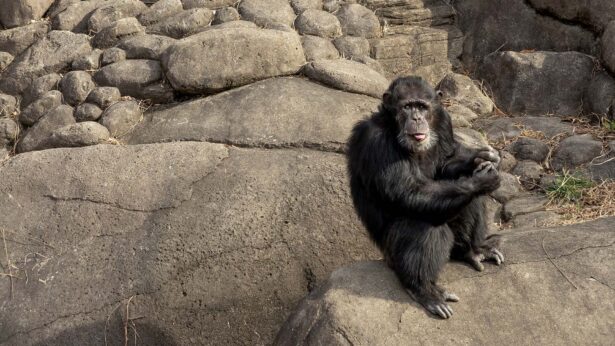
Lu seemed subdued, quiet, not like his normally outgoing self. People around him grew concerned.
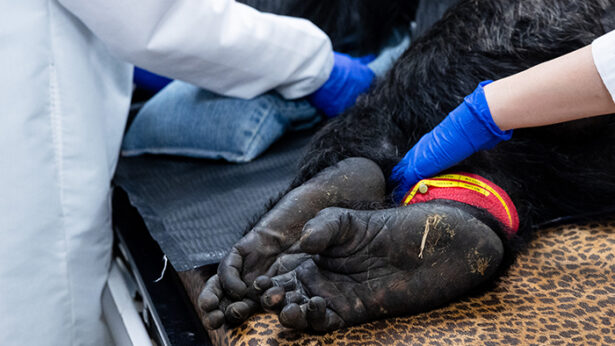
He began dragging one foot and then the other, developing sores on both.
Then came the doctors.
An MRI revealed Lu, a 35-year-old chimpanzee at Zoo Knoxville, had a tumor on his spinal cord. Specialists at the UT College of Veterinary Medicine (UTCVM) first thought radiation would be the best course of action. But Dr. Talisha Moore, a clinical assistant professor and veterinary neurosurgeon, had another thought.

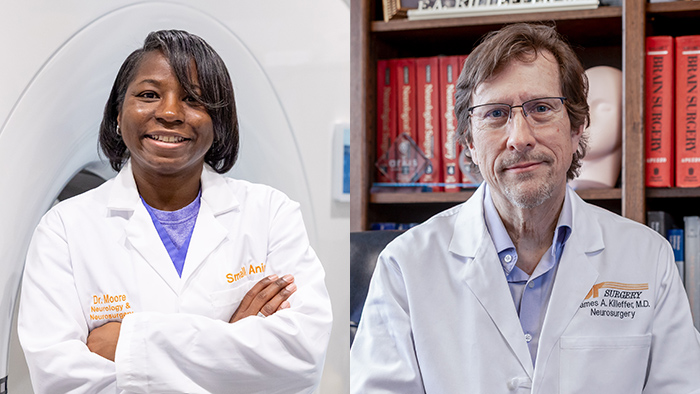
She texted Dr. James Killeffer, the chief neurosurgeon at UT Medical Center and associate professor in the UT Health Science Center College of Medicine-Knoxville, across the river. They already had a working relationship by hosting each other’s residents, consulting and talking about different neurosurgical approaches for animals and humans, speaking at conferences and planning future collaboration.
This partnership between University of Tennessee animal and human doctors proved to be the perfect medicine for Lu.
It also, perhaps, will make its own page in history.
Preparations
Killeffer (UTHSC ’91) looked at the tumor’s images, spoke with the assembled specialists and recommended surgery to remove it. After all, he would do that for a human patient. They set a surgery date in September 2025.
“One of the reasons we got Dr. Killeffer involved was because our thought process was chimps are more like humans than dogs and cats, which we work on all the time,” Moore says. “Given all the circumstances, we thought we could get gross total resection of the mass versus doing multiple rounds of radiation therapy.”
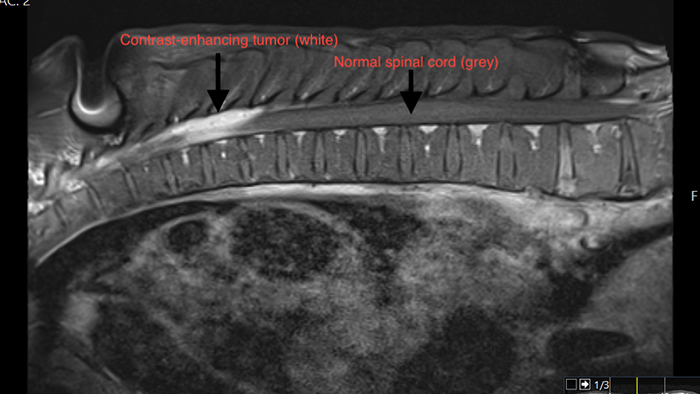
Moore had removed spinal tumors numerous times in cats, dogs and other animals but not chimpanzees. Killeffer had not, either—up to that point, all his patients were human.
“They asked me if I could help do the surgery since chimpanzees’ anatomy is a lot more like humans than most of the animals they operate on,” Killeffer says. “In our practice, I do a lot of trauma, brain tumors and benign spine conditions.”
In fact, Moore and Killeffer think this is the first such operation. They are preparing a journal article to publish and officially document the procedure.
“This is not a routine surgery and, actually, the first documented surgery either Dr. Killeffer or myself could find for a spinal tumor removal in a chimpanzee,” Moore says.
Tumor Effects
The tumor on Lu’s spinal cord interfered with his brain signals, causing him to drag his feet: similar symptoms to what Killeffer might see in his patients.
“A person would similarly have trouble walking, maybe, or the person might notice numbness in the lower part of their body,” he says.
But Lu’s personality really showed his illness’ effects.
“He was not his usual outgoing, bubbly self. He wasn’t interacting with us as he had been and wasn’t playing with Stevie, the younger chimp, like he had been,” says zookeeper Crystal Mugan.
Lu, short for Mwelu, was born at Zoo Tampa and brought to Knoxville as an infant. Concerned zoo officials knew the veterinarians would take good care of him.
“These animals are not just animals; they are our friends and family, and we care for them like they are us,” Mugan says. “We were nervous and anxious and wanting the best for him because he is one of the best animals that we have.”
The Surgery
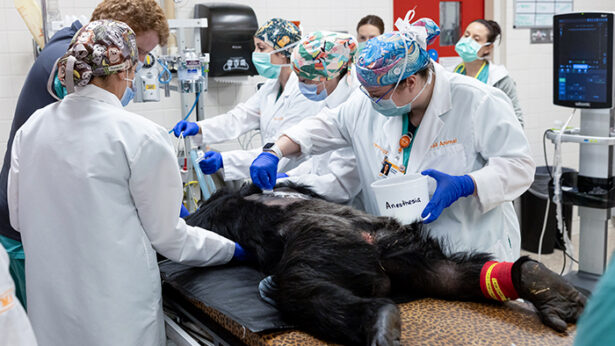
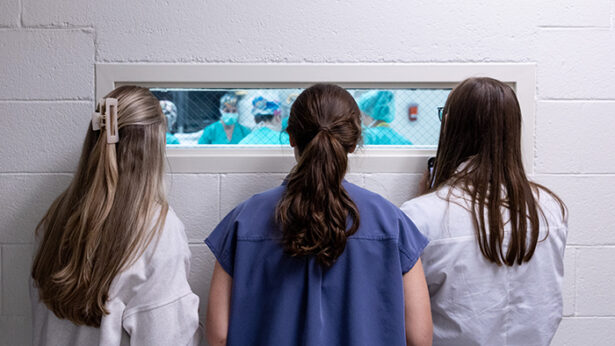
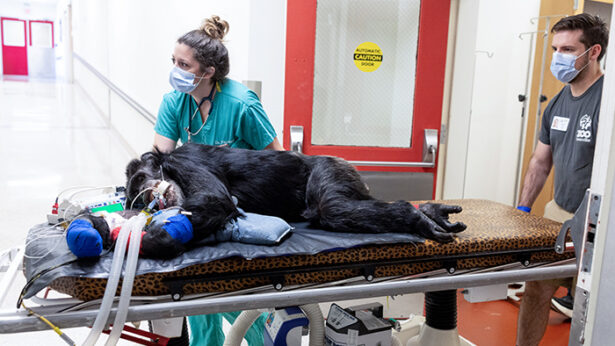
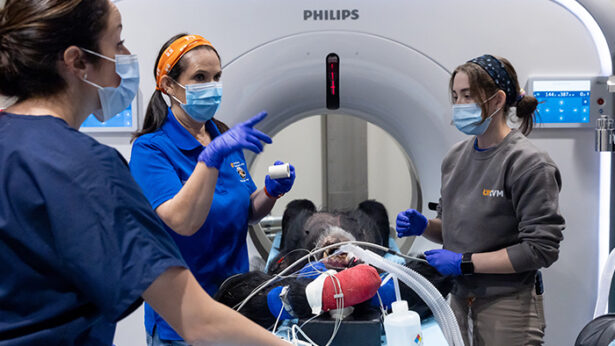
On the morning of the surgery, a team sedated and then transported Lu to UTCVM in a special van. Once he arrived, technicians scanned his spine again to make sure there were no other issues.
“My PA, Henry Hodgson, and I walked into the imaging suite, and there was giant horse asleep on a pallet,” Killeffer says. “To them that’s an everyday occurrence; to us it was completely bizarre.”
Moore, Killeffer and the surgery team began the operation. They removed some of the spinal bone to access the spinal canal and found the tumor.
From there, the procedure was very familiar to Killeffer.
“It looked a lot like operating on a person, so I just went ahead. We talked back and forth about the instruments. Their instruments can be used on people, but they are slightly different than the ones I usually use. They had a very nice set of micro instruments, which is the same as we use on people,” he says.
Click to Expand Images
Before surgery, Moore and Killeffer discussed what kind of tumor it could be. It proved to be an extra osseous hemangioma. Extra osseous means it was outside the bone, and hemangiomas are benign collections of tiny blood vessels, commonly found in people but rarely located in the spine.
“It turns out it was a tumor type we are not very familiar with on the vet med side,” Moore says.
The team removed the entire tumor.
Lu remained sedated after surgery, somewhat to Killeffer’s surprise. He usually visits and talks with his patients post-operation. He asked veterinary neurologist Billy Thomas, who was also involved in the surgery, if he could see Lu the next day.
“He looked at me and said, ‘If you go to the zoo. The chimpanzee is going back to the zoo before we wake him up because, if we wake him up now, he will tear the whole place apart,’” Killeffer recalls. “That is pretty different than people.”
Once Lu returned to the zoo, Moore followed up, checking on him once a week for four weeks.
“We kept him confined and away from the troop, which I’m sure was hard on Lu, but that was what was best for his interest to recover from surgery, so they didn’t get at his incision,” she says.
Mugan, the zookeeper, says Lu seems unfazed by his ordeal.
“You can’t even tell he was out a couple of weeks. He’s recovered well. He’s climbing. He’s back to his playful self,” she says.
Further Collaborations
While Killeffer enjoys telling his colleagues about being the only one of them to operate on a chimpanzee, he and Moore plan more collaborations.
“In all seriousness, it’s one of the novelties of my lifetime, but it’s a really cool collaboration, and Dr. Moore is fantastic, and all those vet guys are fantastic,” he says. “Some of their residents have spent a month with me. They are so much fun. I love to go over and see what they are doing.”
They plan to work more together on hydrocephalus, a buildup of water on the brain, and the treatment of gliomas, malignant brain tumors found in humans and dogs.
“I think there is a lot to be gained and learned on both sides of the aisle,” Moore says. “This story highlights the collaboration between human medicine and veterinary medicine. If we can become more collaborative as a whole, we can accomplish great things.”
Learn More About the Chimp Lu’s Surgery
