


Neurological disorders affect the central nervous system—the brain and spinal cord—and the peripheral nervous system, which involves the nerves throughout the body. They often affect people’s control over their movements and can even lead to paralysis.
These disorders include stroke, Parkinson’s disease, multiple sclerosis and many others. According to a study released by The Lancet Neurology, more than 3.4 billion people worldwide experienced a neurological condition in 2021. An article published by NeuroscienceNews.com in November 2025 reported that 180 million Americans, or 54 percent, have neurological disorders.
At UT Martin, Seth Hatchett has made it his mission to help those facing neurological disorders. It’s an area, he says, where scientific discoveries may still be made.
“We understand so little about how consciousness functions, how the brain processes information, how complex paths are executed by our mind. Getting a better understanding of that would benefit society and could allow us to create a wide variety of technologies like brain-computer interfaces and neural regenerative technologies, which really interests me,” he says. “It’s not just theoretical knowledge that I find interesting; it’s also something that directly benefits society. What I like about entering medicine and becoming a physician scientist is that it actually gives me the opportunity to combine those two interests together.”

To achieve those goals, Hatchett is pursuing degrees in cell and molecular biology, electrical engineering and general chemistry, while minoring in neuroscience. He plans to graduate in spring 2027 and wants to become a physician scientist. In 2025, he received the prestigious Goldwater Scholarship—awarded yearly in a national competition to sophomores or juniors who plan to pursue research careers in natural sciences, mathematics and engineering.
Hatchett, from Huntingdon, works with Saman Sargolzaei, UT Martin associate professor of engineering, to use advanced brain imaging to study neurological disorders. By understanding how disorders affect brain activity, their research aims to improve brain-computer interface technologies that could help restore communication and movement for individuals.
“Our present research at this lab is mostly focused on better understanding the impact of driving on human physiology as well as understanding the neurological activity associated with mental imagery,” Hatchett says. “In the future, I hope to do some research during my final year next year that would be focused on the more therapeutic aspects of modern neurotechnology. Specifically, what I was thinking about is figuring out if there is a better way to diagnose or monitor the progression of brain cancer using EEG (electroencephalogram) technology.”
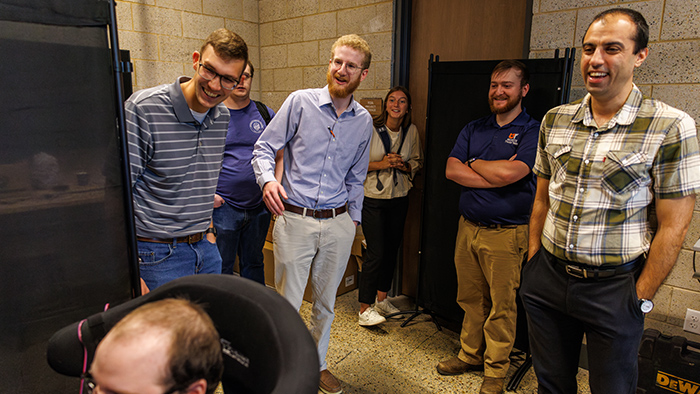
UT Martin’s Brain Autonomy and Resiliency research lab allows researchers to safely study how drivers interact with advanced vehicle technologies in a controlled environment.
Sargolzaei, who has co-authored papers with Hatchett, praised his work with the driving simulator project.
“His hard work in collecting and analyzing physiological signals has advanced our research thrust at the intersection of neurotechnology and intelligent transportation,” Sargolzaei says. “It’s been rewarding to see how quickly he absorbed and applied these complex techniques, demonstrating a strong willingness to learn, curiosity and skill in this cutting-edge field.”
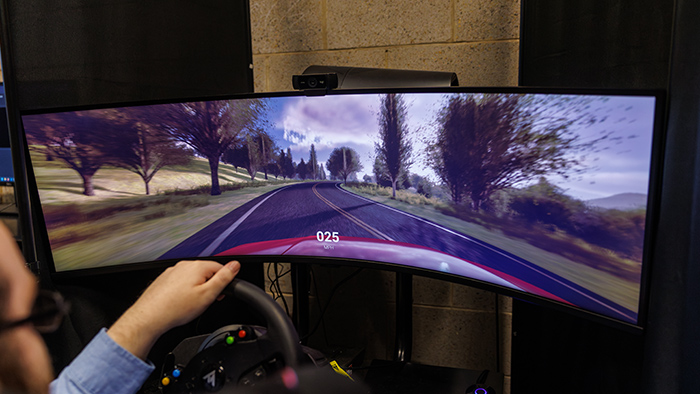
Their research works to understand how a person’s attention, cognitive load and internal mental states interact with complex, real-world conditions. It uses neuroimaging and immersive experimental platforms—such as an extended reality-based driving simulator—to study how people interact with intelligent systems and how the brain allocates cognitive resources under distraction, automation and sensory load.
Integrated with brainwave monitoring, heart-rate analysis and eye-tracking systems, the simulator enables the team to measure cognitive loads and attention as participants drive under manual, AI-assisted and fully autonomous conditions—experiments that would be difficult, costly or unsafe to conduct on the road.
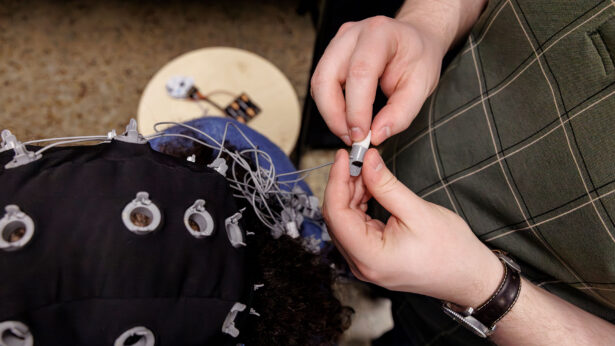
By using sensors in a head cap to measure electrical impulses, the researchers study from which part of the brain they come and what they are meant to control. The impulses also track test subjects’ reactions to what they see on the screen during the simulated driving exercise.
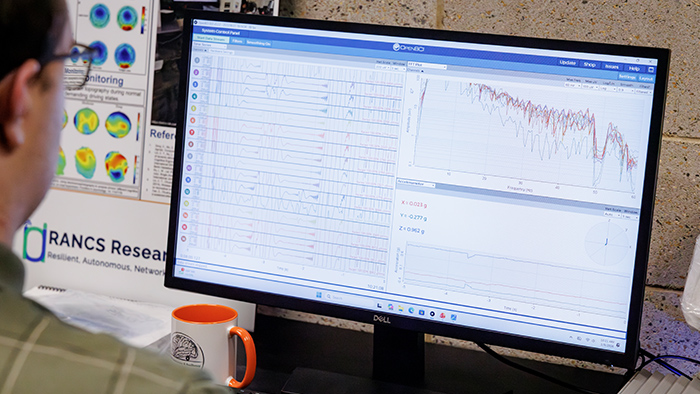
“What we’re doing is collecting physiological signals from participants when they complete the driving simulation study,” Hatchett says. “Specifically, we collect EEG activity, which is the head cap that goes onto the scalp and collects activity about the electrical changes in the brain.”
Students also tracked subjects’ electrocardiograms, or heart rate, and EMGs, or muscle activity activities.
“The focus in our lab has been on better understanding the impact of driving on human physiology as well as understanding the neurological activity associated with mental imagery,” Hatchett says.
Brain cells, or neurons, fire an electrical impulse from the neuron to the axon of the nerve. Neurons that fire an impulse at the same time generate enough charge to be detected by electrodes on the scalp. Those charges can be converted into a digital signal that can be measured to see how the driving process—or any process—impacts the brain.
“There have been efforts to create prosthetics or other such devices to help people with various disabilities to help them regain normal or close-to-normal function by interfacing with their brain,” Hatchett says.
Called brain-computer interface, this allows for brain activity to be monitored and used as input for a computer.
“Once you have a system in place for collecting the brain’s activity, there are various creative ways this can be used to assist people, such as external prosthetics for someone who is absolutely paralyzed but has a robotic arm on wheels that they can move around with their brain and use it to cook dinner or whatever they need,” Hatchett says.
Hatchett says his interest in this area comes from the amount of scientific discovery yet to be made. He wants to become a physician scientist, dividing his time between working as a research professor at a university—conducting research and teaching classes—and practicing medicine as a physician or as a surgeon, depending on which field he chooses.
“We understand so little about how consciousness functions, how the brain processes information and how complex tasks are executed by our mind,” Hatchett says. “Getting a better understanding of that would benefit society and could allow us to create a wide variety of technologies like brain-computer interfaces and neuro-regenerative technologies, which really interest me.
“It’s not just theoretical knowledge which I find interesting; it’s also something that directly benefits society. What I like about entering medicine and becoming a physician scientist is that it actually gives me a chance to combine those interests together.”