


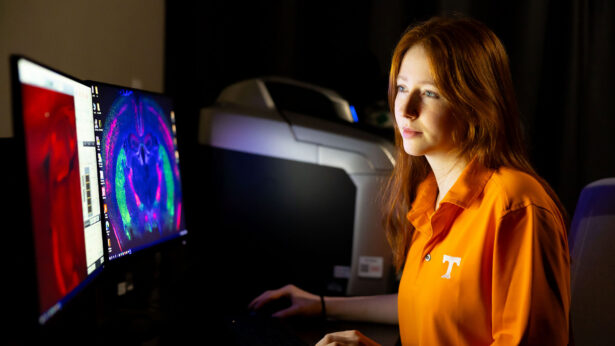
From learning a new instrument to mastering a new sport, the human brain constantly reshapes itself in response to experience. This ability—known as brain plasticity—is essential for development, learning and adaptation throughout life.
At UT Knoxville, neuroscientist Keerthi Krishnan works to understand what happens when that process goes awry and how insights at the genetic and cellular level could inform treatments for neurological disorders.
Krishnan, an associate professor of biochemistry and cellular and molecular biology in the College of Arts and Sciences and director of NeuroNet—a UTK-led interdisciplinary brain research center—studies how genes influence the brain’s capacity to change. Her research spans development and adulthood, health and disease, and sits at the intersection of genetics, behavior and neural circuitry.
“At its core, my work asks how experience shapes the brain,” Krishnan says. “We know that when we learn something new—whether it’s walking, talking or picking up a skill—the brain physically changes. The question is what mechanisms allow that to happen and what breaks down in neurological disorders.”
When communication and experience fall out of sync

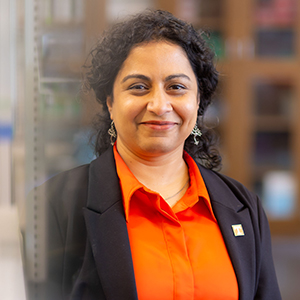
Krishnan’s work explores the idea that some neurodevelopmental disorders arise from a lack of communication between the brain’s internal wiring and the external environment. One disorder that illustrates this disconnect is Rett syndrome, an autism-associated neurological condition in which early development often appears typical but is followed by a period of regression where previously acquired skills are lost.
“In conditions like Rett syndrome, the brain is largely intact,” Krishnan says. “The question is why the cells aren’t communicating in a coordinated way—and how that lack of coordination affects behavior.”
The syndrome is caused by mutations in the gene MECP2, often referred to as a “master regulator” gene because it binds to DNA and influences the activity of thousands of other genes. Despite decades of study, scientists are still working to fully understand why disruptions in the MECP2 gene lead to widespread effects on brain function and behavior.
Krishnan’s lab examines how genetic disruptions influence cellular function, neural networks and behavior across the brain, offering a more integrated view of how the disorder unfolds.
Cellular diversity’s contribution
To study brain plasticity, Krishnan’s team uses a wide array of tools, including genome-wide profiling of gene expression, high-resolution imaging, electrophysiology and behavioral analysis in animal models. Her lab works to understand how specific cell types contribute to learning and to motor skills such as the fine control involved in reach-to-grasp movements.
“One of the challenges in neuroscience is cellular diversity,” Krishnan says. “The brain has thousands of distinct cell types. Understanding which cells matter for which behaviors—and how genes like MECP2 affect them—is incredibly complex.”

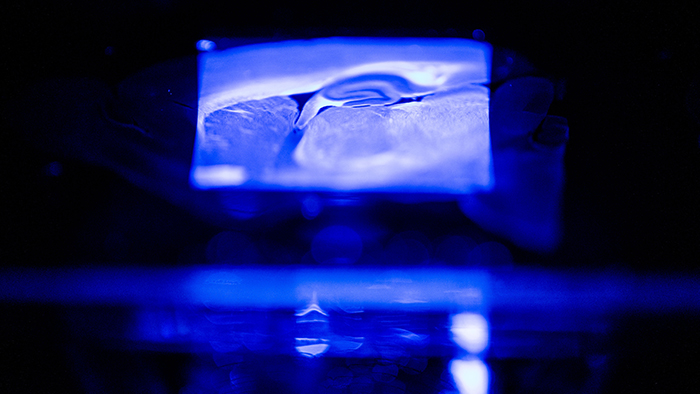
That complexity is amplified in many conditions, such as Rett syndrome, in which some cells express the mutated gene while others do not. Krishnan’s work suggests that the disorder is not caused by the loss of MECP2 in individual cells but by disrupted communication between cells that express the gene and those that do not.
“This shifts how we think about the disease,” she says. “It’s not just about replacing what’s missing. It’s about understanding how networks are formed and maintained—and how imbalance affects the entire system.”
Timing, plasticity and broader implications
Krishnan’s research on Rett syndrome demonstrates timing’s importance. Her work shows that the brain may compensate for genetic disruptions early in development, only to lose that flexibility later in life.
“There are windows when the brain can adapt and maintain function,” she says. “Later, that ability seems to fade. Understanding why that happens—and whether we can extend or restore those windows—is one of the most exciting questions in the field.”
These findings have implications beyond Rett syndrome.
MECP2 is active throughout the body and has been implicated in a range of conditions from cancer to schizophrenia. Studying how this gene works in health and disease could reveal broader principles of brain regulation and resilience.
Machine learning and a systems-level view of the brain
To tackle the scale and complexity of modern neuroscience data, Krishnan’s lab integrates advanced computing and machine learning approaches. Deep learning tools help the team quantify subtle behavioral patterns and connect them to cellular and molecular changes in the brain—analyses that were not possible just a few years ago.
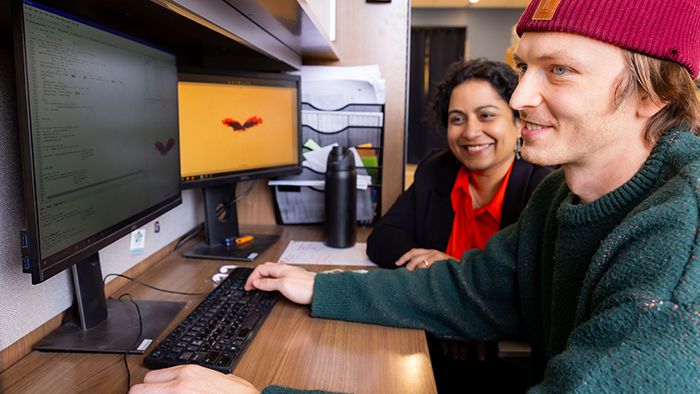
“Neuroscience and computational science now go hand in hand,” Krishnan says. “We’re finally getting to the point where we can analyze whole-brain data and ask questions at a systems level.”
As director of NeuroNet—a research center focused on bridging brain, cognition and behavior—Krishnan helps connect researchers across disciplines and institutions to tackle complex questions about the brain. NeuroNet brings together faculty from 13 departments and four colleges along with collaborators at UT Medical Center and Oak Ridge National Laboratory, creating a collaborative environment where neuroscience intersects with engineering, data science, psychology and medicine.
“No single lab or discipline can solve these problems alone,” Krishnan says. “The brain doesn’t operate in silos, and neither should neuroscience.”
Training the next generation
Undergraduate students, graduate students and postdoctoral researchers in Krishnan’s program gain hands-on experience with cutting-edge techniques while learning how to integrate genetics, behavior and brain circuitry into a single research framework.
Beyond technical skills, Krishnan emphasizes training students to think across levels of biology—and across disciplines.
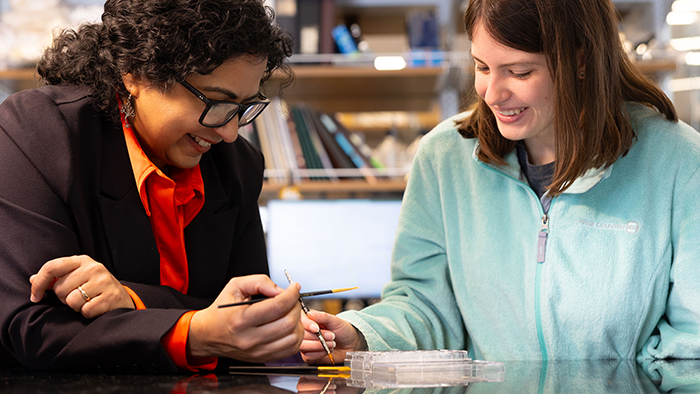
“We’re training students to connect genes, cells and behavior,” she says. “That kind of integrative thinking is essential for where neuroscience is headed.”
Through NeuroNet, students and postdocs connect with researchers across the university and at partner institutions, gaining exposure to perspectives from engineering, psychology, data science and medicine. Those experiences prepare students for careers in academia, industry and health-related fields while strengthening Tennessee’s growing neuroscience and biomedical workforce.
Advancing brain research
As Krishnan’s lab continues to explore how plasticity is established, maintained and lost, the ultimate goal remains to translate discoveries into meaningful improvements in quality of life.
“Understanding how the brain adapts—and why it sometimes can’t—has implications for learning, rehabilitation and neurological disease,” she says. “If we can figure out how to preserve or restore plasticity, even partially, it could make a real difference.”