



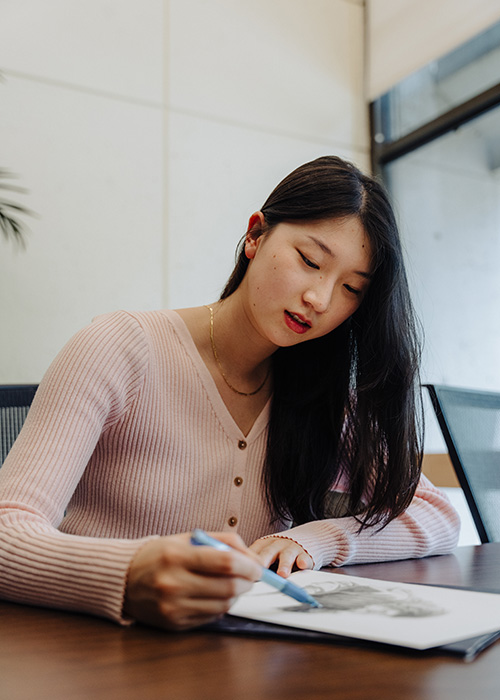
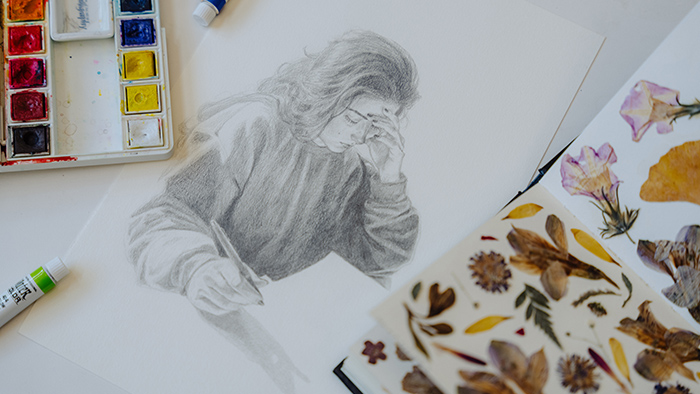
Long before she became a medical student, Emily Lu learned to understand people by drawing their faces.
Growing up near Nashville after immigrating with her family from China, she found portrait drawing a way to form connections that transcended language or cultural barriers.
“There was something about drawing someone’s face that made me feel like I was understanding them on some level or getting closer to them,” she says. “I’ve been doing it ever since.”
As she begins her second year of medical school at the UT Health Science Center, art now provides a different role in her life.
Medical school brought long hours, intense coursework and the pressure of returning to a highly demanding academic environment after taking gap years to work full time. Amid the stress, Lu found herself again turning to art to press pause, reconnect with herself and step away from the constant expectation to be productive.
“It’s been very nice as a way of slowing down, of putting my focus on something else,” she says. “It’s also been good to connect with other people on campus and just take a break together.”
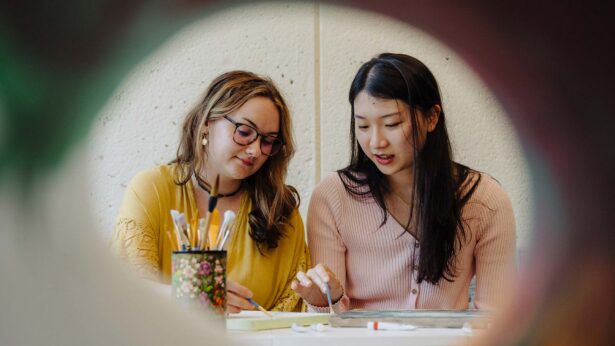
That desire for creative space led Lu and her classmate Pepper Mason to establish the university’s Art Club, an organization to give students across programs a low-pressure outlet for creativity and stress relief.
“It is just a guilt-free way of taking back a couple hours for yourself,” Lu says.
Students pick up canvases and paint supplies and then create alongside classmates before returning to studying, labs and clinics. For many students, those few hours provide relaxation that is increasingly difficult to find in health care education.

“There’s a prominent rhetoric among the students that you need to be studying or doing something productive every single hour of the day,” Lu says. “It’s been a nice way of saying, ‘Hey, take a moment for yourself. Do something that brings you joy.’”
Jess McDill, associate director of leadership and service who serves as Art Club advisor, thinks those moments matter more than many people realize. She has seen an increase in student burnout and mental health challenges during her 20 years in higher education.
“This is a pressure-cooker environment on the best of days,” McDill says. “When you feel like there is so much out of your control, that naturally leads to stress and burnout.”
McDill, who has a background in theater and holds a Master of Fine Arts degree in costume design, sees creativity as essential to human experience as well as an important aspect of health care education.
“We’re not here to be button pushers,” she says. “We’re here to be human and help other people be their best selves along the way.”
According to a 2019 World Health Organization report, art therapy and engagement with the arts reduce symptoms of depression and anxiety, help heal from trauma and improve social connections, among other benefits. Lu saw some of those effects during her undergraduate studies at New York University, where she shadowed art therapy sessions of patients with neurodegenerative and movement disorders.
“It’s a very powerful way to get people to open up and talk about themselves,” she says.
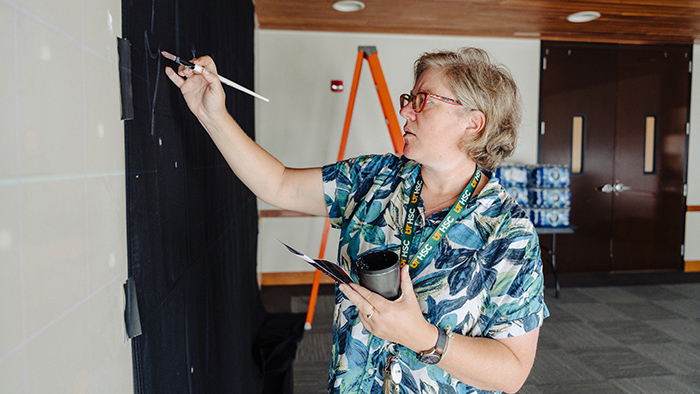
Patients participated in drawing and other creative activities that support fine motor skills and emotional well-being. Beyond the physical benefits, Lu says the sessions fostered conversation and community among participants.
“In the process of doing it, people like to chat and they open up,” she says. “That community really bonded, and the artists were able to support each other.”
McDill thinks those lessons extend into health care.
“Health care is about helping humans, and you can’t help humans if you don’t understand what it means to the human,” she says. “If you can’t connect to the person in front of you, you’re not going to be an effective provider, and if you can’t connect to what makes you human, you’re not going to be effective at taking care of yourself, either.”
While she appreciates the beauty art adds to life, McDill sees it as a vehicle for understanding people, emotions and experiences. These skills she thinks are as important for future providers as technical expertise.
“Health care is about helping humans, and you can’t help humans if you don’t understand what it means to the human.”
—Jess McDill
“I want my doctor to know what it means to me to be able to hold a paint brush or knit or crochet,” McDill says. “One of these students is going to be the doctor that tells me, ‘Hey, you have macular degeneration, and you’re losing your vision,’ or ‘Hey, you have really progressive arthritis, and you can’t sew or knit or crochet anymore.’ I need them to understand what that means as a patient.”
She sees Art Club as an opportunity for students to reconnect with parts of themselves that can easily get lost in highly competitive academic environments.
“Student development doesn’t stop when you get to grad school,” she says. “There are so many stories of students that shave off parts of their identity to get here. To be a whole human being, you need to be a whole human being.”
That idea has resonated with students. During painting sessions, Lu says she enjoys seeing classmates reveal sides of themselves that rarely emerge in academic settings.
“You kind of make an assumption about what they’re like in your head, and then they paint something, and you’re like, ‘Whoa, I did not know you were interested in this at all,’” she says. “It’s another way of learning more about each other.”
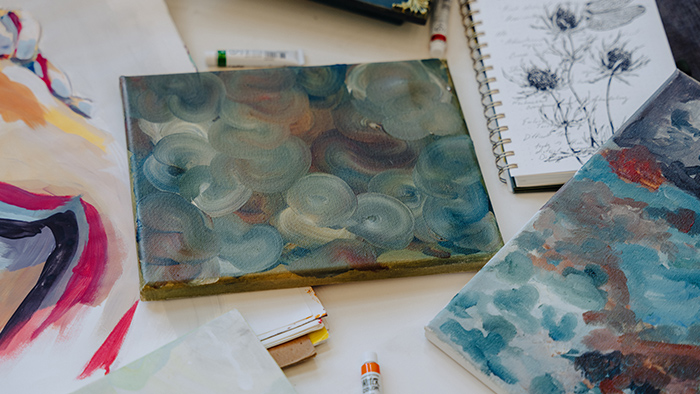
The Art Club leaders hope it continues to grow, and plans include an exhibition of students’ work. For now, it creates space for students to breathe.
“The work always gets done,” Lu says. “You can take a couple hours for yourself and do what you enjoy.”
For her, that still means drawing faces, the same practice that helped a quiet child connect to people around her.