


East Tennessee parents who suspect their child may be on the autism spectrum often encounter the same obstacle: access.
Comprehensive evaluations are time-intensive and require specialized training from medical providers. With the latter in short supply, waiting lists can easily stretch beyond a year, forcing families to make major decisions about education and care without clear guidance from professionals.
The Korn Learning, Assessment, and Social Skills (KLASS) Center at UT Knoxville closes that gap.
Founded in 2009, the center offers comprehensive evaluations and intervention guidance for children, adolescents and adults with learning and developmental differences. Autism spectrum disorders make up a significant portion of its work. In 2025, clinicians completed more than 300 evaluations, each spanning several sessions over multiple weeks, to provide families with a clearer understanding of their child’s needs.
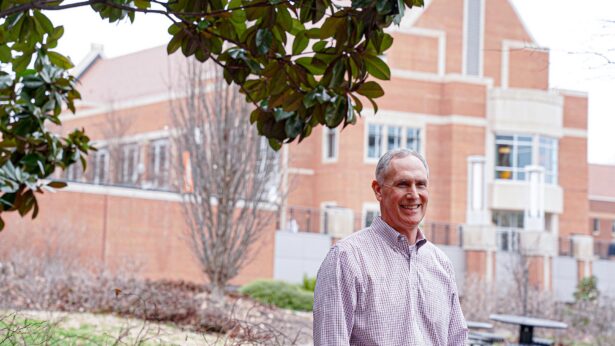
“Most of our clients are from the region, but we’ve had folks drive in to see us from Virginia and Georgia. Some have flown in from New York City. One family flew in from Senegal, based on a referral from a friend who was living in the area,” says Brian Wilhoit (Knoxville ’91, ’95, ’00), a licensed psychologist who has served as director since 2009.
After earning his Ph.D., Wilhoit spent a decade at Cherokee Health Systems (now River Valley Health). When the idea of establishing a center arose, he was a natural fit to lead it.
“Building the KLASS Center was an opportunity to develop something bigger that could provide more resources and services to a broader community,” Wilhoit says. “At the same time, it allowed us to exponentially expand the service provision of the school psychologists we were training and sending out all over the country.”

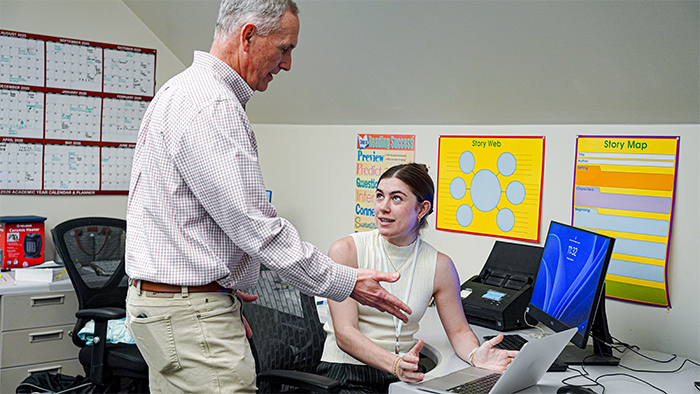
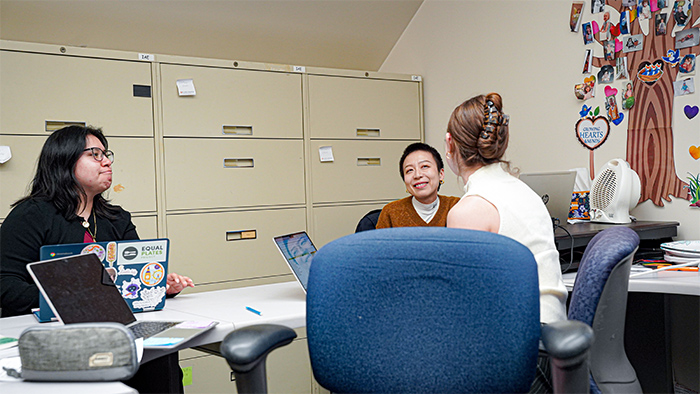
Located on the fourth floor of the Claxton Education Complex, the center staffs two full-time psychologists, two part-time psychologists and a rotation of postdoctoral students, interns and doctoral practicum students. Together, they provide diagnostic evaluations for autism, ADHD and other developmental concerns, as well as academic and behavioral interventions tailored to each individual.
“What we do is very goal-oriented,” Wilhoit says. “We want to help them with the knowledge and skills to live a better life.”
With a shortage of psychologists in East and Middle Tennessee capable of providing the kind of assessment and intervention the KLASS Center offers, the center’s growth has been driven organically through word of mouth and physician referrals.
Knoxville family physician Alan Haney, a graduate of both UT Knoxville (’06) and the UT Health Science Center (’10), sees patients from infancy through adulthood and is often the first to hear parental concerns about developmental challenges. Standard screenings are only the first step.
“A lot of times, you’re on the fence,” Haney says. “You have parental concerns or your own concerns, and what families really need is a deeper evaluation.”
Access to that level of assessment can open the door to critical educational and behavioral support.
“The longer you delay a diagnosis, the longer you delay access to services,” Haney says. “You can’t erase a diagnosis, but you can help create coping and learning skills early on that minimize some of the challenges a child might face later.”
That becomes vital during adolescence and young adulthood when academic expectations intensify, learning environments change and independence becomes a social requirement. The KLASS Center meets those needs in two ways: the Postsecondary Autism Support Services Program (PASS) and FUTURE, a postsecondary education program.
PASS serves degree-seeking students who require help with social interactions, organization and skills that can be complicated by a college environment.
Southern California native Johnny Currado, whose son Brett was diagnosed with autism at 5, relocated with his family to Knoxville in 2019.
“The PASS program was an absolute godsend,” Currado says. “I do not think my son would be where he is today without that program and all that was involved in working with him.”
“The longer you delay a diagnosis, the longer you delay access to services. You can’t erase a diagnosis, but you can help create coping and learning skills early on that minimize some of the challenges a child might face later.”
—Alan Haney
By working with Carolyn Blondin, PASS director, and her team, Brett learned to live independently, joined campus and community groups, and became deeply involved in intramural golf. Brett earned a bachelor’s degree in journalism from UT Knoxville in 2023, an achievement his father attributes to the guidance and structure PASS provided.
“From the moment we stepped on campus and met Dr. Blondin, we knew this was a place where he could grow and graduate,” Currado says.
FUTURE serves young adults on the autism spectrum who have other intellectual and developmental disabilities. Rather than earning credit toward a degree, FUTURE prioritizes practical coursework, internships and daily routines that mirror adult responsibilities. Students often live in university housing or nearby apartments and participate fully in campus social life.
Senior Emily Detre arrived at UT Knoxville from Ringgold, Georgia, in 2022, unsure of what to expect. FUTURE helped her thrive. She now lives in an apartment across the river from campus, balances classes and internships, serves as a UT Knoxville student senator in the Student Government Association and as president of its Unified Special Olympics Club.
“I never thought I could go to college with my disability,” Detre says. “People have told me that before. But look at me now.”
Through FUTURE, Detre learned to advocate for herself. She also discovered a passion for policy and disability advocacy. In addition to interning with the Sertoma Center, which serves adults with intellectual disabilities in East Tennessee, and UT President Randy Boyd’s office, she has audited courses in the Baker School of Public Policy and Public Affairs that align with her career goals.
“The program helped me grow so much,” Detre says. “I have a lot of sass and attitude. I call myself the Girl Boss. It’s helped me to be confident in myself and not hide who I am.”
For Sean Casey, a 2024 FUTURE graduate from Rutledge, the program offered a second chance. After a rocky start in a technical program after high school, his parents saw a nightly news feature highlighting how the program helped students live independently. Casey experienced the benefits immediately.
“The inclusion was my favorite part,” Casey says.
He made close friends through the Best Buddies program, which pairs students with and without intellectual disabilities for one-to-one friendships. He learned job readiness skills that helped him secure employment as a patient transporter in the emergency department at UT Medical Center. Through his time in the program, Casey also cultivated an unexpected passion for solo travel, regularly flying to Chicago; Washington, D.C.; and other cities to ride their public transit systems.
“I was not like this before FUTURE,” Casey says. “Without the program, I would not have the confidence or the independence to travel the country like a nomad.”
For Wilhoit, the success of programs like PASS and FUTURE underscores the center’s larger mission of assisting students who would struggle without this support, assisting parents through the autism journey and training the next generation of psychologists to take their model nationwide.
“The KLASS Center is an extension of the university’s responsibility to the people it serves,” Wilhoit says.
Learn More About the KLASS Center
