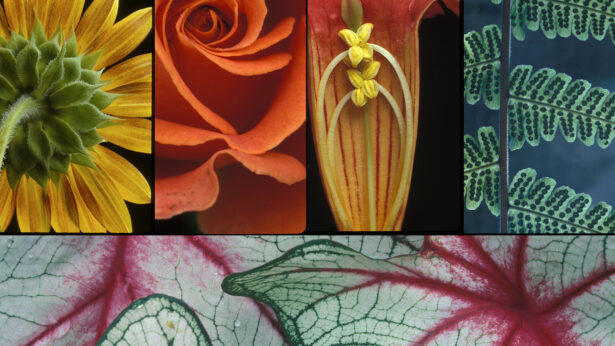
Alan Heilman, a UT Knoxville botany professor and photographer who died in 2017, credited his second-grade teacher with influencing his career. At the end of the school year, the teacher gave him a paper pot with soil and a few sunflower seeds. Heilman planted them alongside his house, where they grew as tall as his roof.
Heilman discovered photography when his father built a darkroom in their basement. Soon after, he received his first camera as a Christmas gift—a used, German-made Kodak Recomar 33 equipped with a double extension bellows that could hold 9-by-12-centimeter cut film or, with an adaptation, color roll film.
His career would put both to use.
Heilman earned his bachelor’s and master’s degrees from the University of Pittsburgh and his doctorate in botany from Ohio State University. He began his career with UT Knoxville’s Department of Botany in 1960 and taught there until his retirement in 1997.
In a fitting tribute to how his botany career began, Heilman’s photograph of a sunflower won first prize in the Carnegie Museum of Natural History’s 1996 Natural World Photographic Competition. The sunflower, he says in an interview, was his most adored subject.
Heilman never owned a digital camera. The only digital process used in the archive’s creation was scanning from prints and slides—performed by staff of the University of Tennessee Libraries. Heilman meticulously selected his best shots to be preserved in the archive. His collection reflects a lifelong fascination with the intricate forms of plants. Many of his photos feature enlargements of pistils, stamens and other anatomical structures. His work is organized into categories of bark, buds, cones, flowers, fruits, fungi, leaves, lichens, mosses, seeds, stems, trees and wood.
Heilman continued his passion well after retirement and could often be found at the UT Gardens, studying his favorite subjects. Since his death, his work lives on in The Botanical Photography of Alan S. Heilman.
From the Archives
In the Summer 1984 issue of Tennessee Alumnus, the article “Relax, Kids!” details the importance of early childhood wellness habits.
Maureen Groer, UT Knoxville nursing professor, first measured children’s blood pressure and then used a game-type health quiz called wellness tic-tac-toe, with the blocks of the game representing wellness habits such as exercise, sleep, salt use, tooth brushing and seat belt use. In her study, Groer discovered that stress-related factors—such as watching TV before bed, anger and difficulty relaxing—were the strongest risk factors related to high blood pressure. She worked with students to teach them relaxation and breathing exercises to combat stress.
Children, she found, are highly receptive to wellness habits and could influence their parents to practice good habits. She advocated for all children in school to receive health and wellness education to build healthy habits for their futures.
Our Tennessee was published as the Tennessee Alumnus from 1917 to 2020. Scanned archives of past issues of the magazine can be accessed online through UT Knoxville’s Digital Collections Library.